How to Choose the Right Custom Software Development Partner in 2026: A Buyer's Framework
Last Updated : 09/09/2026
Estimated : 14 min read
Author : Lokesh A
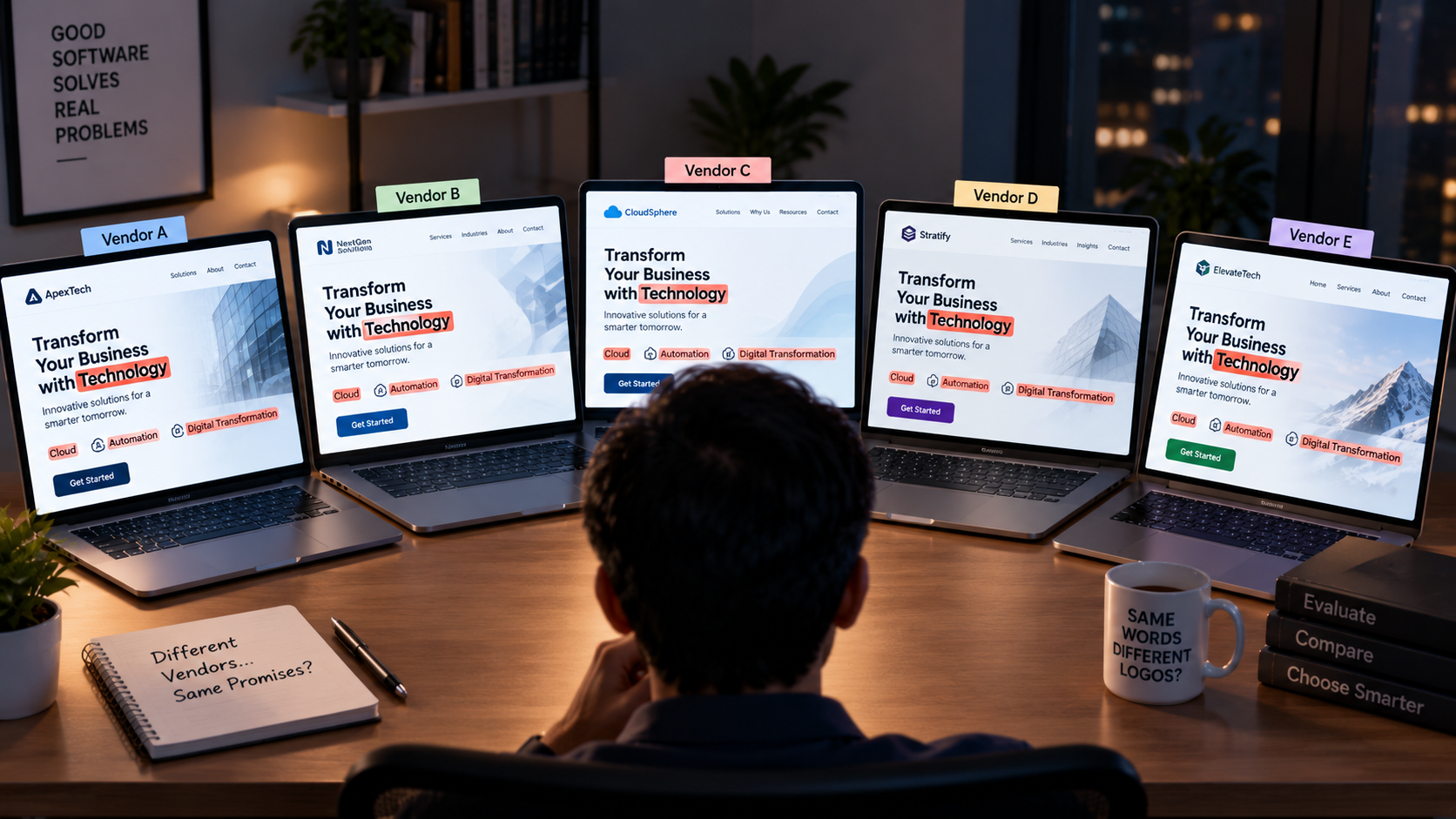
Table of Content
- Every Website Says the Same Thing
- What Does "Custom Software Development" Actually Mean?
- Why So Many of These Projects Go Wrong
- The Real Root Causes (Not the Ones People Usually Blame)
- Red Flags to Watch For Before You Sign
- The Buyer's Framework — Questions That Actually Separate Good Partners From Bad Ones
- Build vs Buy vs Offshore — Where This Fits
- A Realistic Example
- What's Coming Next
- Frequently Asked Questions
- The Bottom Line
Every Website Says the Same Thing
Open ten custom software development company websites. Read their homepages. You'll see the same words again and again: "skilled team." "Fast delivery." "Cost savings." "Trusted by 500+ clients."
None of that tells you anything useful. It's not that these companies are lying. It's that this kind of marketing language is so common, it has stopped meaning much at all.
Here's the real problem this creates: you have to make a big decision — often worth six or seven figures — using almost no real signal. Get it wrong, and you don't just lose money. You lose months of time you can't get back, and sometimes you inherit code nobody can safely touch.
This guide gives you a real framework. Plain questions. Real numbers. No marketing language.
What Does "Custom Software Development" Actually Mean?
Let's start simple. Custom software is software built specifically for your business, instead of a ready-made product everyone else also uses.
Think of it like the difference between buying a suit off the rack and having one tailored. Off-the-rack works fine for a lot of people. But if your business does something unusual, that changes. Maybe you have a specific workflow. Maybe an industry rule applies only to you. Maybe your system needs to talk to three other tools you already use. In these cases, custom-built software fits in a way ready-made tools often can't.
The tricky part isn't deciding whether you need custom software. Most companies asking this question already know they do. The hard part is picking who builds it for you — because the wrong choice is expensive in ways that don't show up until months later.
Why So Many of These Projects Go Wrong
Before picking a framework, it helps to understand what actually breaks. The data here is more specific than most people expect.
A well-known Standish Group analysis found that only 29% of technology projects finish on time and on budget (source:S3Corp, Why Software Outsourcing Projects Fail). Large IT projects, on average, run about 45% over budget and 7% over schedule — and still deliver 56% less value than expected when they finally launch.
More recent research offers a slightly less alarming, but still serious, picture. PMI's 2025 data puts outright project failure at 8 to 11%. A separate study by Whitelane, covering roughly 7,000 outsourcing relationships, found an average client satisfaction rate of 76% (source:MiloSolutions, Software Outsourcing Challenges). Most projects don't collapse completely. But a meaningful share disappoint. And the older, scarier failure rates people love to quote were actually discredited by IEEE Software back in 2010. Treat any project claiming an exact "outsourcing failure rate" with a little healthy doubt.
Here's a cost detail worth remembering. Fixing a bug after the software has already launched costs 6 to 15 times more than catching it during development, according to IBM's research (source:Emvigotech, Software Development Outsourcing Buyer's Guide). This is exactly why the questions later in this guide focus so heavily on process, not just price.
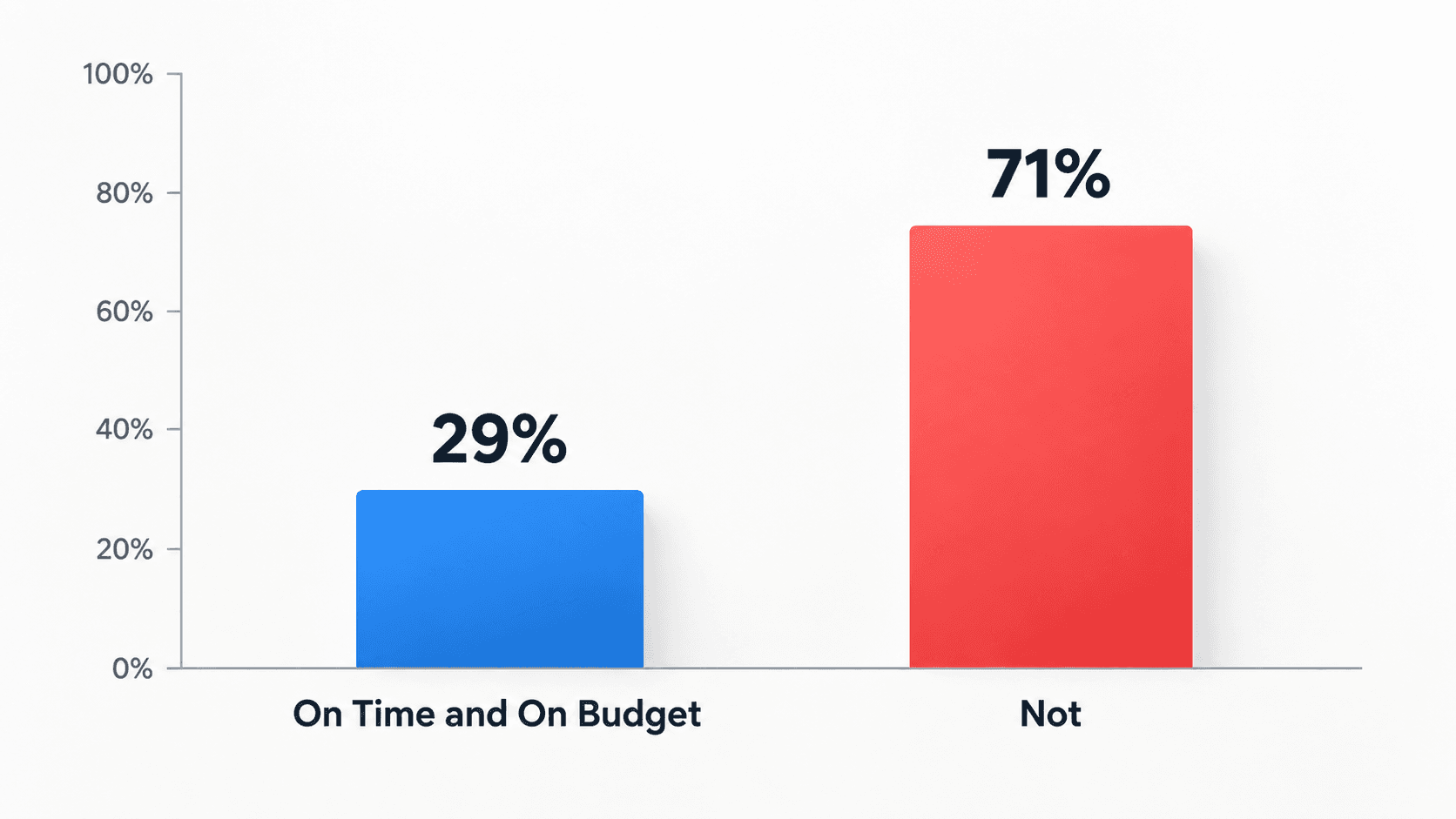 Only 29% of technology projects finish on time and on budget — 71% do not
The Real Root Causes (Not the Ones People Usually Blame)
Most people assume failed software projects come down to bad coding. The data says otherwise.
A widely cited industry breakdown of outsourcing success and failure factors found:
- 55% of failed engagements never set up clear success metrics or reporting from the start.
- 53% point to weak change management — the client side wasn't prepared for how the new system would change daily work.
- 47% cite poor integration between the vendor's work and the client's existing systems (source:Keyhole Software, Software Development Outsourcing Statistics 2026).
Notice what's missing from that list: "the code was badly written." It happens, but it's rarely the main reason projects fail. Most failures start with unclear goals and weak governance — not bad engineers.
This matters because it changes what you should actually be evaluating in a vendor. Coding skill is necessary, but it's not sufficient. You also need a partner who insists on clear goals before writing a single line of code.
Red Flags to Watch For Before You Sign
These are drawn from real vendor-evaluation research, not guesswork.
- "Contact us for pricing" with nothing else. Some flexibility in pricing is normal. But total secrecy, combined with pressure to sign quickly, is a pattern worth noticing.
- Vague answers about who owns the code. Ask directly: will you own the intellectual property and source code, fully, in writing? A study on outsourcing patterns found something striking. 70% of companies have brought some previously outsourced work back in-house over the past five years. A common reason is simple: they discover the code they paid for can't be maintained without paying the original vendor forever (source:AcquaintSoft, Red Flags When Outsourcing).
- No reference from a project that had problems. Every serious, experienced vendor has had at least one difficult project. Ask for that reference specifically, not just their best success story. A vendor with real experience will discuss what went wrong and how they recovered. One with something to hide will change the subject (source:MiloSolutions).
- They won't introduce the actual engineers. It's common for senior, experienced staff to run the sales conversation, then hand the real work to a more junior team after the contract is signed. Ask specifically to meet the people who will write your code — not just the people who will sell it to you.
- No visible process for testing or code review. A mature partner should be able to describe this clearly. How do they catch bugs before you see them? Look for automated testing, structured code review, and a real release process (source:Webellian, IT Outsourcing Trends 2026).
- High staff turnover, or they won't share this data at all. If key engineers keep leaving mid-project, your system's institutional knowledge leaves with them. A trustworthy vendor can tell you, honestly, how long their engineers typically stay.
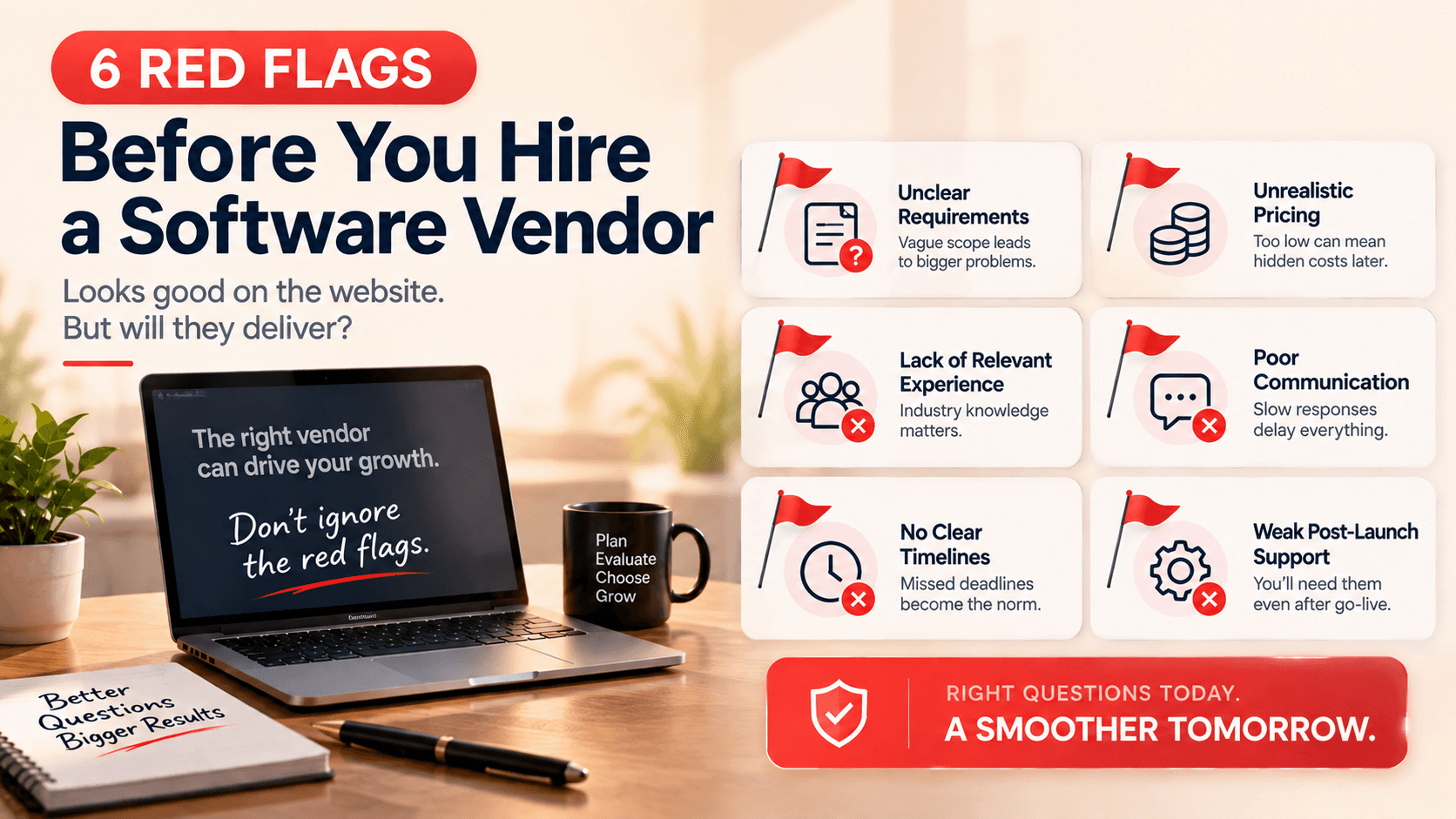 Six red flags to check before signing with a custom software vendor
The Buyer's Framework — Questions That Actually Separate Good Partners From Bad Ones
Use these in your next vendor call. Watch not just what they answer, but how comfortably they answer it.
- "Walk me through a project that went wrong, and what you changed afterward." This single question filters out more bad vendors than any pricing comparison.
- "How do you define 'done' for a feature, before you start building it?" Vague answers here predict scope creep later.
- "What does your testing and code review process actually look like, day to day?" Ask for specifics — tools, frequency, who's responsible.
- "If we need to change direction three months in, what happens to cost and timeline?" This tells you whether their pricing model can handle real-world change, or punishes you for it.
- "Can I speak to a client whose project had a rough patch, not just your best one?" A confident, experienced vendor will have someone for this.
- "What's your average engineer tenure on long-running projects?" This is a proxy for how much institutional memory you'll actually keep over time.
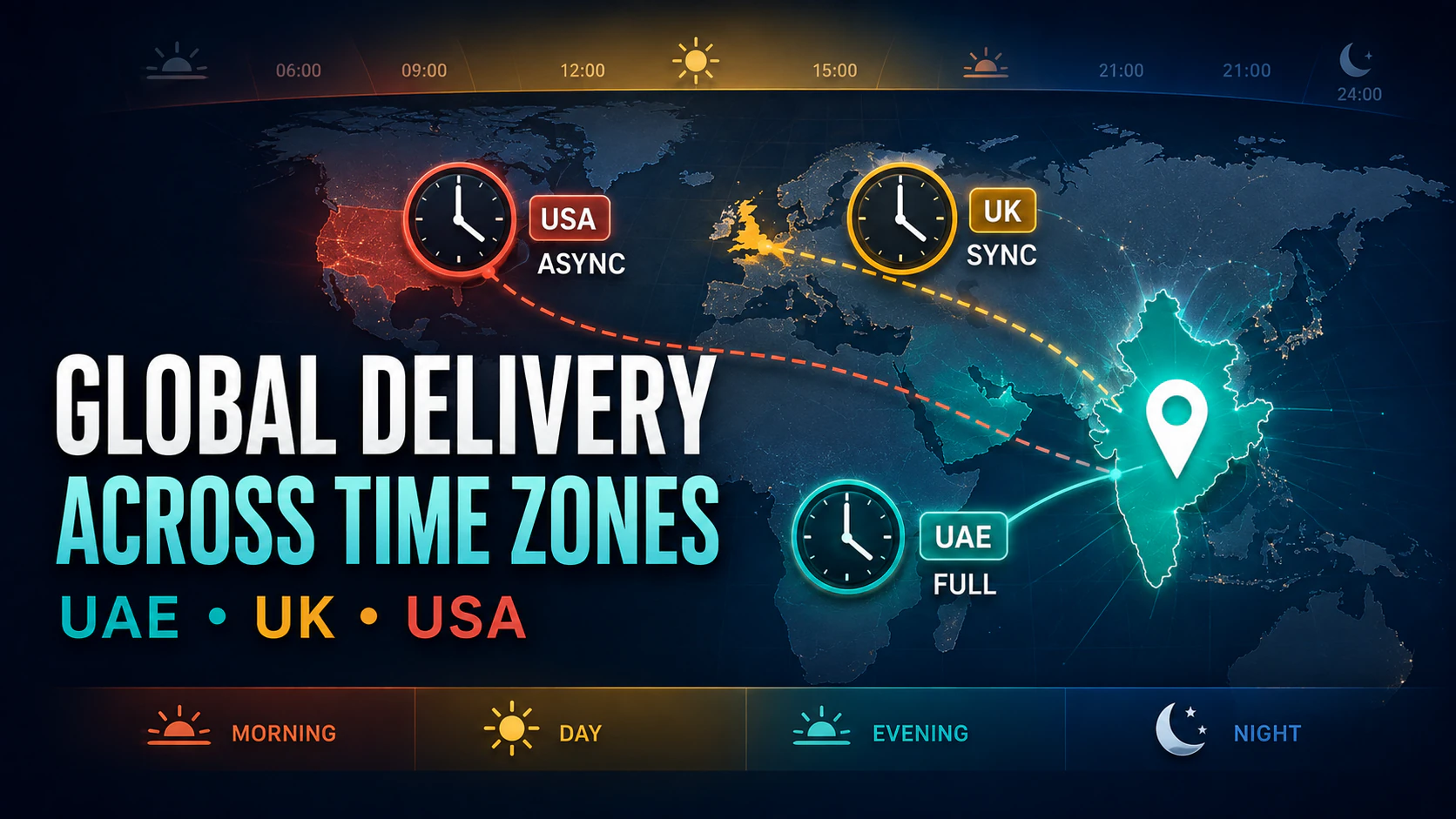
Our own team has spent 17 years buildingcustom web applicationsandmobile applications. Our clients span India, the UAE, UK, USA, Canada, and Singapore. We're glad to answer every one of these six questions directly, including the uncomfortable ones.
Build vs Buy vs Offshore — Where This Fits
Before choosing a partner, it's worth confirming custom development is even the right call.
- Buy a ready-made product when your need is common — accounting, basic CRM, standard project management. Someone has almost certainly already built this well.
- Build in-house when the software is core to your competitive advantage, and you can realistically hire and retain the right skills long-term.
- Build with an outsourced or offshore partner when you need specialised skills you don't have internally. This also fits when you need to move faster than an internal hiring process allows. This is where the framework above becomes essential. The partner you choose directly decides whether this path saves money — or costs you more in the long run.
Increasingly, companies also run a hybrid model: an internal team owns the strategy and architecture decisions, while an external partner handles delivery execution (source:Emvigotech). This tends to combine the control of in-house work with the speed and flexibility of outsourcing.
A Realistic Example
Picture a retail company in the UAE that needed a custom inventory system connecting its warehouses, its point-of-sale terminals, and its finance team.
Their first attempt, with a low-cost offshore vendor chosen mainly on price, went smoothly for the first two months. Then requirements needed to shift slightly — a common, normal part of any real project. The vendor's fixed-price contract treated every small change as a new, separately billed request. Costs crept upward. Communication slowed. Six months in, the company owned a partially working system and a vendor relationship nobody trusted anymore.
Starting over, they used a structured evaluation instead of a quick price comparison. They asked about a past difficult project. They asked to meet the actual engineers. They confirmed, in writing, that they would fully own the code. The second build took a similar amount of time. But this time, when requirements shifted — as they always do — the conversation was about adjusting the plan together. It wasn't a battle over scope.
What's Coming Next
AI is changing what "good" looks like in custom development — but not in the way most marketing suggests. AI tools are speeding up how fast code gets written. That shifts the real bottleneck to reviewing that code carefully and understanding the system's architecture. Teams with deep context and closeness to your business become more valuable, not less. That's because the cost of an unnoticed AI-assisted mistake grows just as fast as the benefit of AI-assisted speed.
Expect more scrutiny on IP ownership, not less. Companies keep reclaiming previously outsourced code once they hit this exact problem. Expect serious vendors to make code ownership and access terms clear upfront. It shouldn't be something you have to dig for.
"Show me, don't tell me" evaluation will keep growing. Buyers are increasingly asking for real code samples. They want live technical interviews with the actual delivery team. Many now ask for a small paid pilot project before committing to anything larger. This framework already points you toward that same approach.
Frequently Asked Questions
Costs vary enormously by scope and complexity, so any single number is misleading. A more useful question is whether your vendor can explain, clearly, what drives their estimate — hours, complexity, and the specific features involved.
Not inherently. The data suggests governance, clear requirements, and vendor selection matter far more than geography alone. A well-managed offshore partnership regularly outperforms a poorly managed local one.
Asking about a past project that had problems tends to reveal more than any other single question, because it's hard to fake a thoughtful answer to it.
Not necessarily. Testimonials show marketing effort more than delivery quality. A reference call, where you can ask direct questions, tells you far more than a quote on a website.
Not automatically. Fixed-price contracts can become expensive and adversarial the moment requirements need to change — which they almost always do. Ask how change requests are handled before assuming a fixed price protects you.
It depends entirely on scope. But be cautious of any vendor promising an unusually fast timeline for a genuinely complex system. This is one of the clearest warning patterns behind later budget and quality problems.
The Bottom Line
The vendors that talk the most about being "trusted" and "experienced" are rarely the ones who can actually answer specific, uncomfortable questions about a project that went wrong. Use the framework above, ask the six questions directly, and you'll learn more in thirty minutes than any homepage could tell you in a month.
Talk to VeeTee — see real client references and a sample project timeline.Schedule a consultationor exploreVeeTee's approach to custom software developmentin detail.
Related Reading on the VeeTee Blog
External Sources Referenced in This Article
- S3Corp —Why Software Outsourcing Projects Fail & How to Prevent It
- MiloSolutions —Software Outsourcing Challenges: Common Pitfalls and How to Avoid Them
- Keyhole Software —Software Development Outsourcing Statistics 2026
- AcquaintSoft —Red Flags When Outsourcing Python Development
- Emvigotech —Software Development Outsourcing: The Complete Buyer's Guide
- Webellian —IT Outsourcing Trends 2026: What CIOs Need to Know
Statistics in this article are drawn from published industry research as of 2026 and are meant to guide your evaluation process, not replace direct reference checks with any vendor you're considering.
Get in Touch
Contact Us
+91 9500945700
adm@vttech.in
No: 8/65, 1st Floor, Radhakrishnan Street, Shankaran Avenue, Velachery, Chennai, Tamil Nadu – 600042, India.
We’re here to help you !