
IT Outsourcing to India: What Companies in the UAE, UK, and USA Actually Get — vs What Vendors Promise
Last Updated : 18/08/2026
Estimated : 16 min read
Author : Lokesh A
Table of Content
- Introduction
- Why India, Why Now: The Market Reality Behind the Pitch
- What Vendors Promise vs What You Actually Get, By Geography
- The Six Realities No Vendor Brochure Volunteers
- The Real IP Protection Framework
- Choosing the Right Engagement Model
- Looking Ahead: How Offshore Delivery Changes Through 2027
- How VeeTee Structures Offshore Engagements Differently
- Book a free offshore engagement scoping call
- Frequently Asked Questions (FAQ)
Introduction
Every offshore vendor pitch sounds identical. “World-class talent.” “Seamless communication.” “24/7 support.” “Your IP is fully protected.” By the time a decision-maker in Dubai, London, or Chicago has taken five discovery calls, the brochures have blurred into one indistinguishable promise. What almost none of those brochures cover is what actually happens after the contract is signed — the real time zone friction, the communication protocols that either work or quietly fail, and the gap between an IP clause that reads well and one that actually protects you.
India's technology sector is on track to reach $300 billion in annual revenue in 2026, representing roughly 10% of national GDP according to NASSCOM, and India holds approximately 17.58% of the entire global software outsourcing market — nearly one-fifth of all offshore software services delivered worldwide. This scale is exactly why the gap between vendor promise and vendor reality matters so much: a market this large contains both the best technology partners in the world and a long tail of underqualified ones wearing the same marketing language. This guide is written specifically for IT directors and operations heads in the UAE, UK, and USA evaluating an India-based partner — covering what changes by geography, the realities no pitch deck volunteers, and how to structure an engagement that actually works. VeeTee Technologies has deliveredoffshore engineering and IT consultingacross all three of these markets for 17 years — this comes from what we have seen work and fail, not from a sales script.
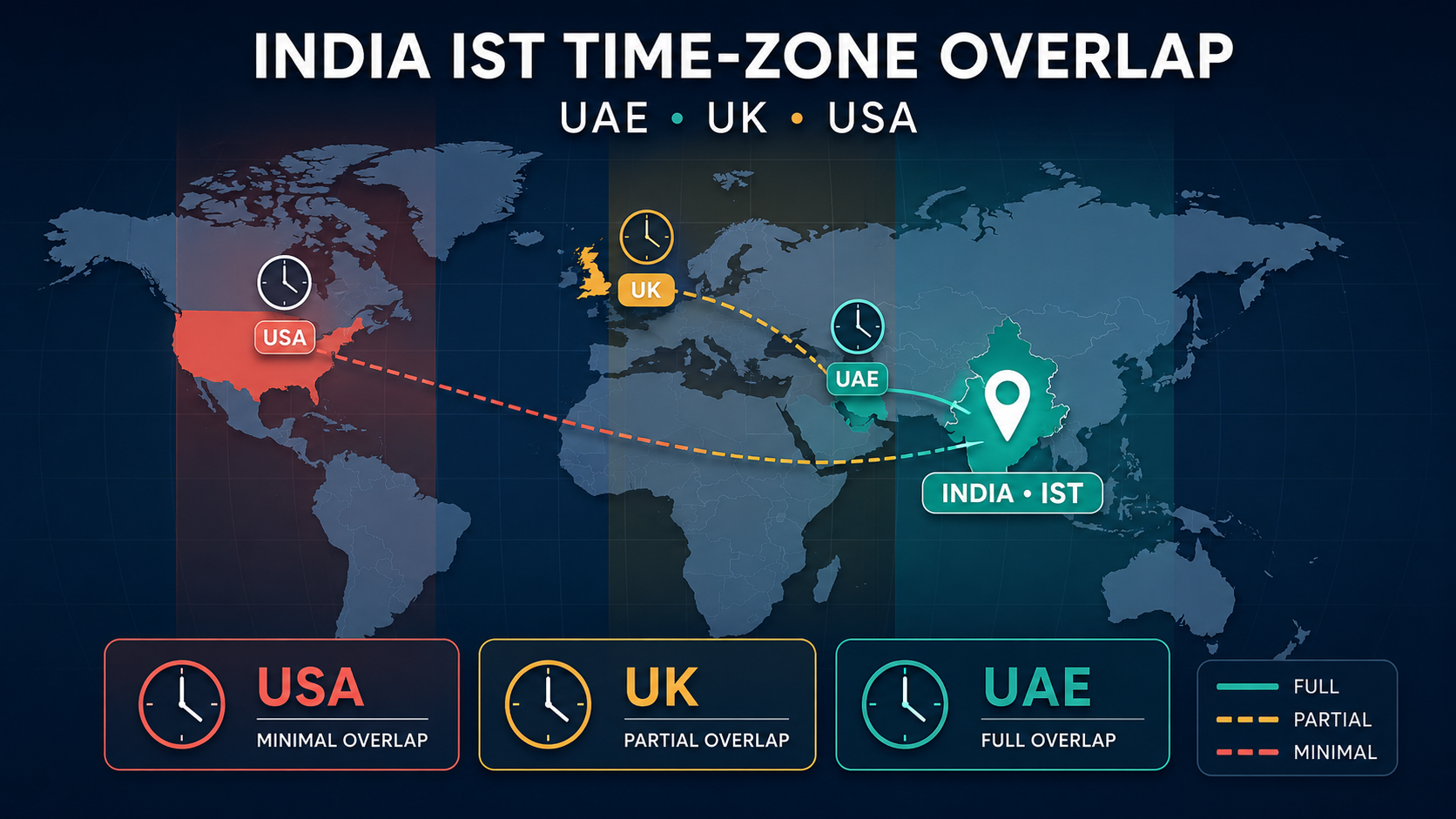 Map visual: India IST time zone overlap with UAE, UK, USA — full, partial, minimal overlap bands
Why India, Why Now: The Market Reality Behind the Pitch
India's outsourcing dominance is not a legacy advantage coasting on reputation. 54% of U.S. companies that outsource software development choose India as their preferred destination, backed by a developer talent pool exceeding 5.4 million engineers. The country's primary competitors — Eastern Europe (Poland, Romania, Ukraine) and Southeast Asia (Vietnam, the Philippines), with Latin America competing mainly for US-timezone work — each have a legitimate use case, but none matches India across cost, talent depth, technical breadth, and delivery maturity simultaneously.
What has genuinely changed for 2026 is the nature of the work, not just its volume. Banking, financial services, and insurance now represent 30.29% of global IT outsourcing demand, the single largest sector — meaning the offshore teams handling this work have had to mature into regulated, audit-ready delivery organisations, not just staff-augmentation shops. Inflation in India is stabilising, with the central bank projecting a fall to around 2% in 2026, which matters more than it sounds: predictable long-term partner economics is what allows a UK or US enterprise to plan a three-year offshore roadmap rather than renegotiating rates annually.
What Vendors Promise vs What You Actually Get, By Geography
Generic outsourcing advice treats “the client” as a single persona. In practice, a UAE-based operations head, a UK IT director, and a US CTO are solving different problems, and the vendor promise that sounds identical on a call means something different in delivery for each of them.
UAE: The Full-Overlap Promise Is Usually True — the Compliance Promise Often Isn't
India (IST, UTC+5:30) has full working-hours overlap with the UAE (UTC+4) — a 1.5-hour gap that barely registers in practice. Vendors correctly sell this as a genuine advantage: real-time collaboration, same-day standups, no async handoff delay. What the pitch typically glosses over is data residency and regulatory alignment specific to UAE sectors — banking, healthcare, and government-adjacent work increasingly expect data handling aligned to UAE data protection law and sector-specific frameworks, not a generic “we follow ISO 27001” answer. Ask specifically how the vendor's data handling maps to UAE requirements, not just international certification badges.
UK: The 4–5 Hour Overlap Window Needs an Explicit Operating Model
India shares roughly 4 to 5 working hours of overlap with the UK, enough for a genuine daily sync window but not enough for the constant real-time collaboration UAE clients experience. Vendors often undersell this distinction, implying “good overlap” without specifying what it actually enables. Apex IT Solutions' 2026 buyer guide recommends the fix directly: define a fixed daily overlap window of two to three hours for synchronous reviews, and run everything else asynchronously through a shared issue tracker rather than assuming the whole day will feel collaborative. A vendor who proposes this structure proactively, before you ask, is signalling operational maturity most competitors only discover after the relationship has already strained.
USA: Minimal Same-Day Overlap Means the Delivery Model Itself Must Change
The US time zone gap with India is the most significant of the three — minimal same-day overlap under standard working hours. This is the geography where vendor promises diverge most sharply from reality. Some vendors quietly staff US-facing accounts with reduced offshore capacity during genuine overlap hours and market it as “dedicated support,” when what is actually happening is a handful of early-morning or late-evening calls layered on top of a standard IST working day. T-Mat Global's 2026 offshore guide recommends the honest structure: async-first workflows using recorded updates and a shared tracker, combined with two genuinely scheduled live calls per week — not a vague promise of round-the-clock availability that nobody can sustainably deliver.
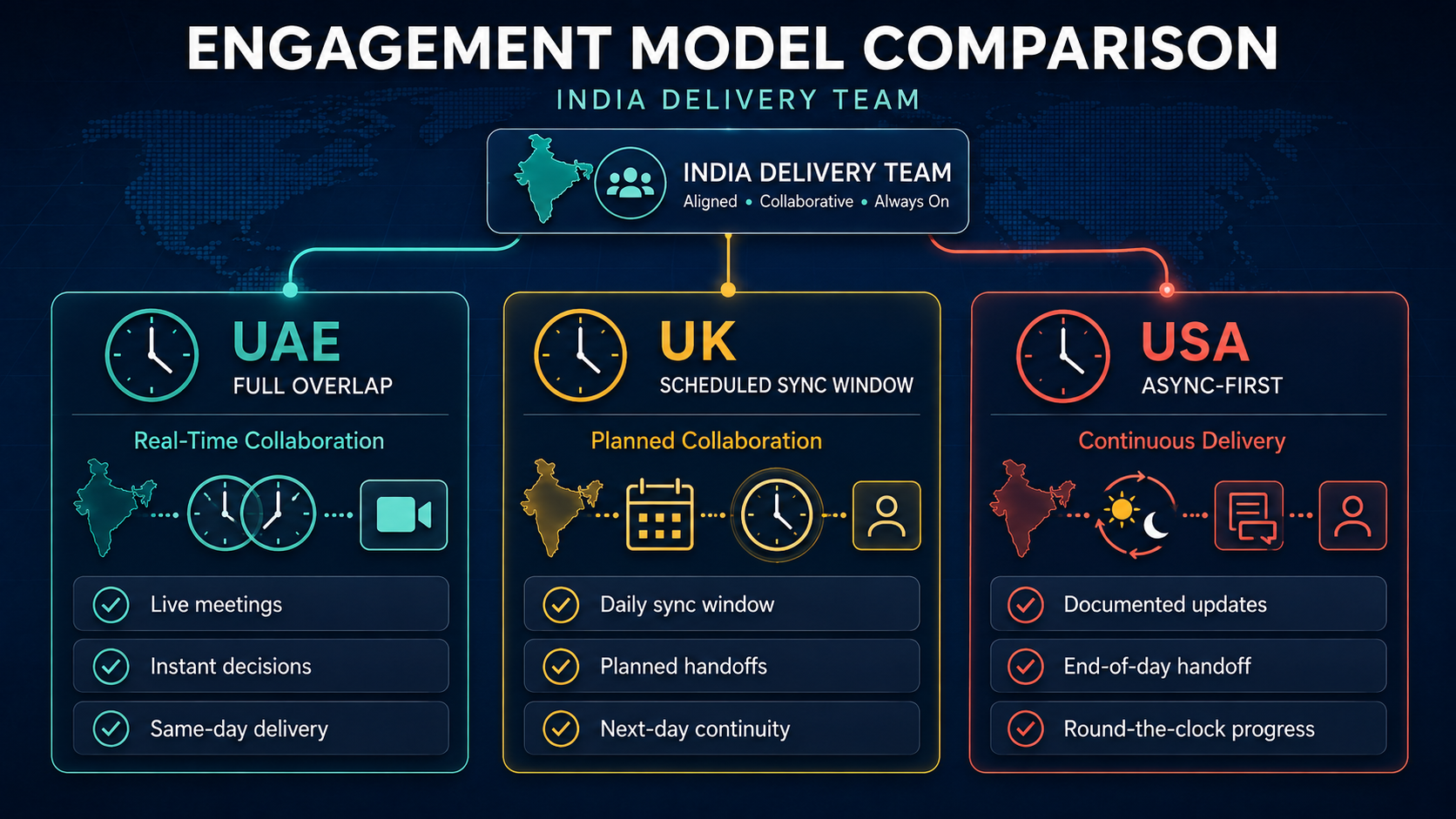 Engagement model comparison: full overlap (UAE) vs scheduled sync window (UK) vs async-first (USA)
The Six Realities No Vendor Brochure Volunteers
Beyond time zone, the durable pattern across successful and failed offshore engagements comes down to six specific factors — documented consistently across recent buyer-side research from Riseup Labs' 2026 offshore playbook and Apex IT Solutions.
1. Communication quality is a skill gap, not a language gap
CVs read fluently; the real test is a live technical conversation with the named senior engineer, not the sales lead, discussing a genuine ambiguity or disagreement. Vendors who route every pre-contract conversation through account management rather than engineers are signalling something about post-contract reality.
2. Accountability erodes with distance unless it is structurally enforced
A single named lead engineer who owns delivery, plus weekly demonstrations of working software rather than status slide decks, is the standard fix. If a vendor cannot commit to a named lead before signing, that ambiguity does not resolve itself after signing.
3. Intellectual property protection depends on contract mechanics, not intention
A mutual NDA and a general “IP belongs to you” clause are necessary but insufficient. IP assignment should be signed by individual developers, not only the vendor company, and your code should live in your own repository from day one — not the vendor's, transferred later.
4. Quality variance between offshore vendors is enormous — larger than the variance between countries
The spread between the best and worst India-based vendors is wider than the spread between India and its regional competitors, which is precisely why vendor-specific due diligence matters more than country-level reputation.
5. Rate anomalies are information, not bargains
Offshore developer rates in 2026 run roughly $20–$35/hour in India as a realistic market band; a quote significantly below that floor is a signal about who will actually staff the work, not a negotiating win.
6. A paid trial reveals what no proposal can
A structured two-to-four week paid engagement, even a small one, surfaces communication patterns, technical depth, and delivery discipline that a sales process — designed specifically to present well — cannot.
The Real IP Protection Framework
Every offshore vendor claims IP protection. Very few buyers verify the mechanics that actually deliver it. WIPO's guidance on international outsourcing agreements flags one of the most common and costly assumptions: that NDAs and confidentiality agreements hold up uniformly across jurisdictions. Many jurisdictions lack the enforcement mechanisms or legal precedent to support an IP breach claim quickly or affordably, which means the governing law and venue named in your contract determine whether your protection is real or theoretical.
A defensible framework has four specific components, each independently verifiable before you sign: your code, cloud accounts, and domain registrations live under your ownership from day one, with no exceptions during development. IP assignment is signed by each individual developer working on your project, not only by the vendor entity — because a company-level assignment does not automatically bind every engineer who touches your codebase in every jurisdiction. The contract specifies a governing law and dispute-resolution venue where enforcement is realistic given the vendor's actual assets and operations, not just where it is convenient to draft. And your NDA and IP terms are reviewed by counsel familiar with cross-border enforcement, not treated as commodity boilerplate.
Choosing the Right Engagement Model
The three common offshore engagement structures each solve a different problem, and vendors often default to whichever model is easiest for them to sell rather than the one that matches your actual need. Staff augmentation — embedding individual offshore engineers into your existing team and processes — fits organisations with mature internal engineering management who need capacity, not direction. A dedicated team model, where the vendor provides a self-contained team with its own technical lead reporting into your organisation, fits mid-to-long engagements where you want delivery ownership offshore but strategic control retained onshore. Project-based, fixed-scope engagement fits well-defined, bounded work with clear acceptance criteria, but is the model most vulnerable to scope disputes when requirements evolve — which, in most real software projects, they do.
The honest vendor conversation names which model fits your situation and why — rather than proposing whichever model is most profitable for the vendor to staff. VeeTee'soffshore development practicescopes this explicitly during the discovery call, before any commercial proposal, because the wrong engagement model is the single most common root cause we see in offshore relationships that underperform.
Looking Ahead: How Offshore Delivery Changes Through 2027
The next phase of India-based offshore delivery is already visible in how leading vendors are restructuring their delivery models. AI-augmented engineering — where offshore teams use coding assistants andagentic development toolsto compress delivery timelines — is moving from experimental to standard practice across serious vendors, which means the honest 2027 pitch will increasingly be about how a vendor's senior engineers direct and verify AI-assisted output, not just how many junior developers they can staff. Software development trend analysis for 2026 points to the same shift: organisations across India, the USA, UK, and UAE are moving toward AI-native, cloud-first, secure-by-design delivery models as the baseline expectation, not a premium add-on.
The Global Capability Centre (GCC) model — where a foreign enterprise establishes its own captive engineering unit in India rather than contracting a third-party vendor — is also accelerating, particularly among UK and US mid-market enterprises that have outgrown pure vendor relationships but are not ready for the capital commitment of a full subsidiary. For many organisations, a mature vendor partnership is the practical bridge to a future GCC, giving you the delivery model and market knowledge before you commit to standing up your own entity.
How VeeTee Structures Offshore Engagements Differently
VeeTee Technologies has delivered offshore software development, Oracle andSAP engineering,cloud migrationand BI implementation for enterprise clients across India, UAE, UK, USA, Canada, and Singapore for over 17 years, with ISO-compliant delivery processes across every engagement. We name your lead engineer before you sign. Your code lives in your repository from the first commit. Our engagement proposal specifies the overlap model — full sync, scheduled window, or async-first — matched to your actual time zone, not a generic promise of round-the-clock availability. And every IP and confidentiality clause in our standard contract is structured around enforceability, not boilerplate.
Book a free offshore engagement scoping call
Whether you are shortlisting an India-based partner for the first time or trying to fix an offshore relationship that is already underperforming, a short review with an experienced team will surface the risks that matter most for your geography and delivery model.Talk to our offshore delivery teamto book yours — no commitment required.
Frequently Asked Questions (FAQ)
How much working-hour overlap do UAE, UK, and US companies actually get with an India-based team?
How much working-hour overlap do UAE, UK, and US companies actually get with an India-based team?
India (IST, UTC+5:30) has near-full working-hours overlap with the UAE, roughly 4 to 5 hours of overlap with the UK, and minimal same-day overlap with standard US business hours. This is a structural time zone fact, not something a vendor can meaningfully change — what a good vendor can do is design the right operating model (full sync, a fixed daily overlap window, or async-first) around whichever overlap you actually have.
What is a realistic hourly rate for offshore software development in India in 2026?
What is a realistic hourly rate for offshore software development in India in 2026?
Realistic 2026 market rates for India-based offshore development run approximately $20 to $35 per hour, varying by seniority, specialisation, and vendor tier — compared to roughly $37/hour average in Eastern Europe and $50/hour in Latin America. A quote meaningfully below this floor is not a bargain; it typically indicates junior staffing, undisclosed subcontracting, or unsustainable vendor economics that surface later as quality or continuity problems.
How do I verify that an offshore vendor's IP protection clause is actually enforceable?
How do I verify that an offshore vendor's IP protection clause is actually enforceable?
Check four specific things: your code, cloud accounts, and domain live under your ownership from day one; IP assignment is signed by each individual developer, not only the vendor company; the contract's governing law and dispute-resolution venue is realistic given where the vendor has actual assets and operations; and the clause has been reviewed by counsel experienced in cross-border enforcement rather than treated as standard boilerplate. A well-written clause that is unenforceable in practice provides no real protection.
What is the difference between staff augmentation and a dedicated offshore team?
What is the difference between staff augmentation and a dedicated offshore team?
Staff augmentation embeds individual offshore engineers directly into your existing team and processes, with your own management providing direction — best suited to organisations with mature internal engineering leadership that need additional capacity. A dedicated team model provides a self-contained offshore team with its own technical lead, better suited to organisations that want delivery ownership offshore while retaining strategic control onshore. Choosing the wrong model for your internal management maturity is one of the most common causes of underperforming offshore relationships.
Should a company set up its own Global Capability Centre in India instead of using a vendor?
Should a company set up its own Global Capability Centre in India instead of using a vendor?
A Global Capability Centre (GCC) — a captive, wholly owned engineering unit in India — makes sense once an organisation has outgrown vendor relationships in scale and strategic importance and is ready for the legal, HR, and capital commitment of establishing an entity. For most mid-market UK and US enterprises, a mature offshore vendor partnership is the practical route to build delivery experience and market knowledge before committing to a GCC, rather than an either-or decision made upfront.
Get in Touch
Contact Us
+91 9500945700
adm@vttech.in
No: 8/65, 1st Floor, Radhakrishnan Street, Shankaran Avenue, Velachery, Chennai, Tamil Nadu – 600042, India.
We’re here to help you !