What Every CTO Should Know Before Building an Agentic AI System in 2026
Last Updated : 04/08/2026
Estimated : 12 min read
Author : Lokesh A
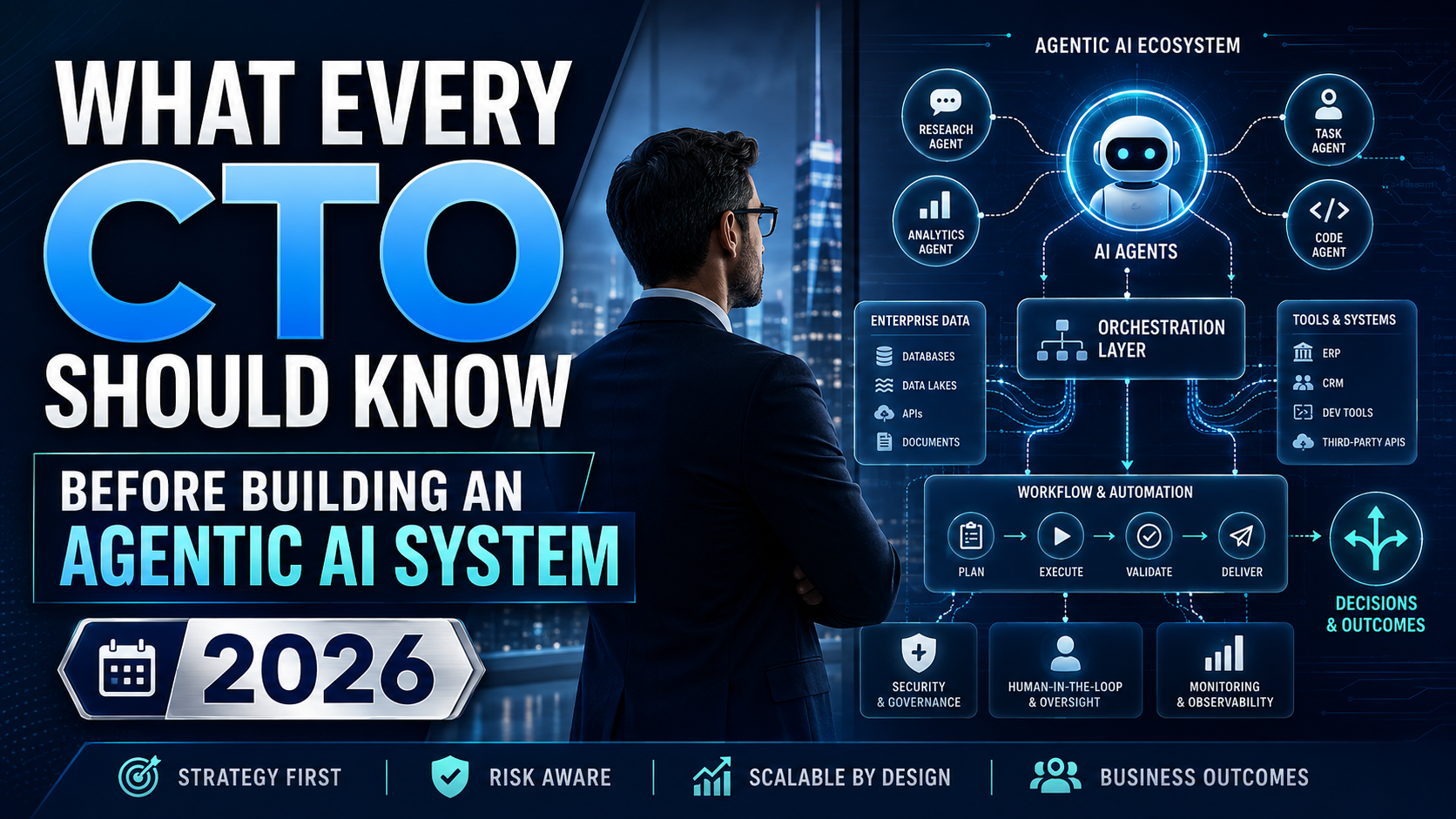
Table of Content
- Introduction
- What Agentic AI Actually Is — And Is Not
- The Four Architecture Decisions That Determine Success or Failure
- The Four Failure Modes Quietly Sinking Enterprise AI Projects
- Build vs Buy vs Partner: The Right Framework for 2026
- The First 90 Days: A Practical Roadmap for CTOs
- Conclusion
- Ready to build your enterprise agentic AI system — properly?
- Frequently Asked Questions (FAQ)
Introduction
The term “Agentic AI” moved from academic whitepapers to board-level roadmaps in roughly 18 months. By the end of 2026,Gartnerestimates that 40% of enterprise software applications will integrate task-specific AI agents — up from fewer than 1% in 2024. That is not incremental adoption. That is a platform shift of the same magnitude as the move from on-premise infrastructure to cloud.
Yet according to Deloitte's State of AI in 2026 report, 74% of companies plan to deploy agentic AI within the next two years, while only 21% report having a mature governance model for autonomous agents. The gap between aspiration and infrastructure is substantial — and it is where most enterprise AI projects currently fail. CTOs who close that gap first do not just gain efficiency; they redefine what their category looks like to buyers and competitors.
This guide cuts through the noise. It covers whatAgentic AIactually is, the four architectural decisions that determine whether your deployment succeeds or stalls, the failure modes that are quietly sinking enterprise AI projects right now, and what a practical first 90 days should look like.VeeTee Technologieshas built production agentic AI systems for enterprises in the UAE, UK, and India — the patterns here come from real deployments, not proof-of-concept demos.
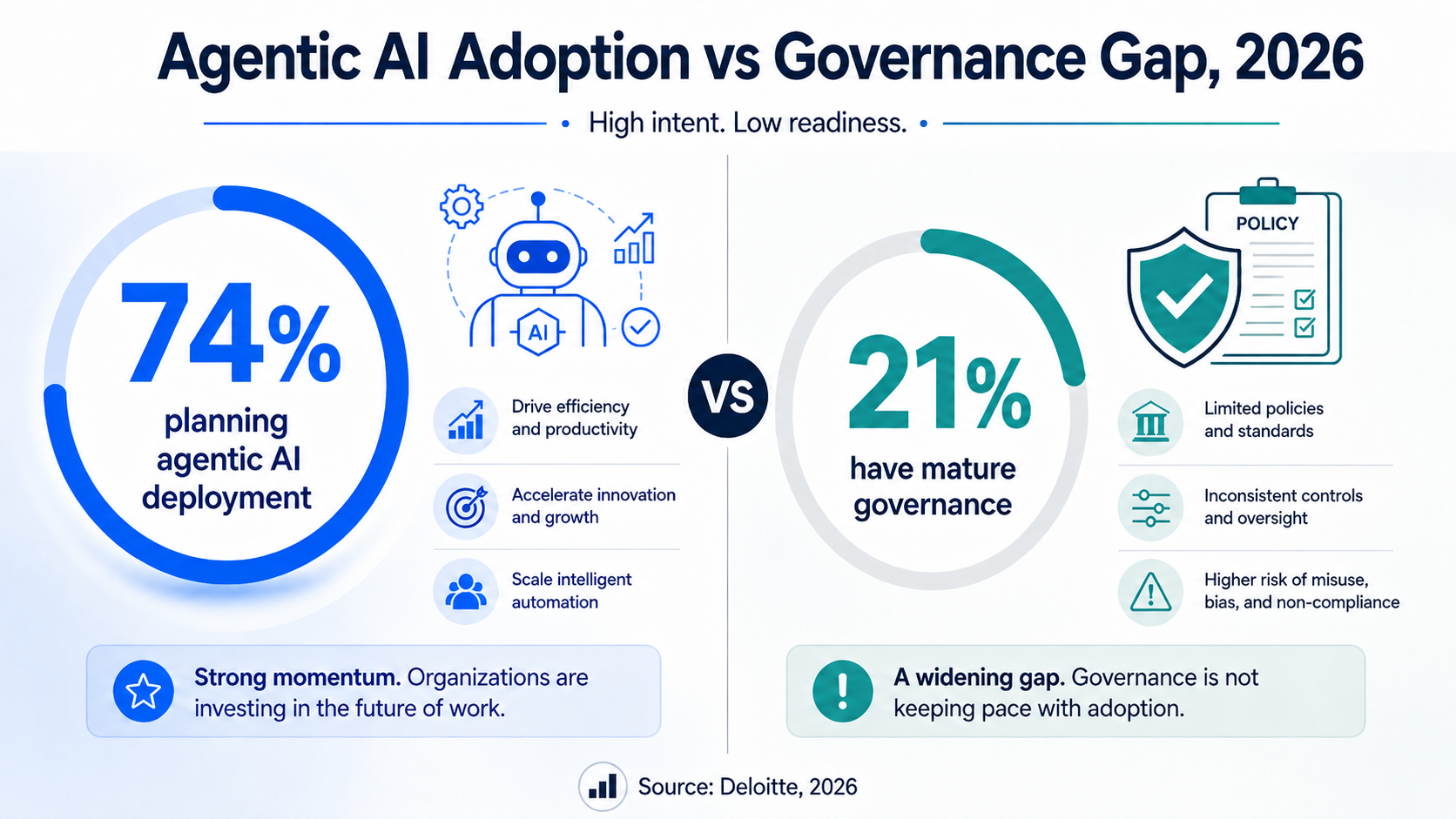 The governance gap: 74% of companies plan agentic AI, only 21% have a mature governance model — Deloitte, 2026
What Agentic AI Actually Is — And Is Not
Most organizations currently calling something “agentic AI” are running sophisticated chatbots with API access. That is not an insult — it is a starting point. True agentic AI is architecturally different in three ways: it maintains persistent state across multi-step tasks, it adapts based on intermediate feedback rather than following a fixed script, and it coordinates with other agents to decompose complex problems into parallel workstreams.
The shift from a single-LLM prompt to a production multi-agent system is architectural, not merely algorithmic. A financial audit agent does not just answer a question — it ingests filings, runs valuation models, flags anomalies, drafts narratives, and escalates borderline items to a human reviewer. Every step involves state persistence, decision logic, and external tool calls. The infrastructure that makes this reliable at enterprise scale is very different from what runs a well-prompted LLM wrapper.
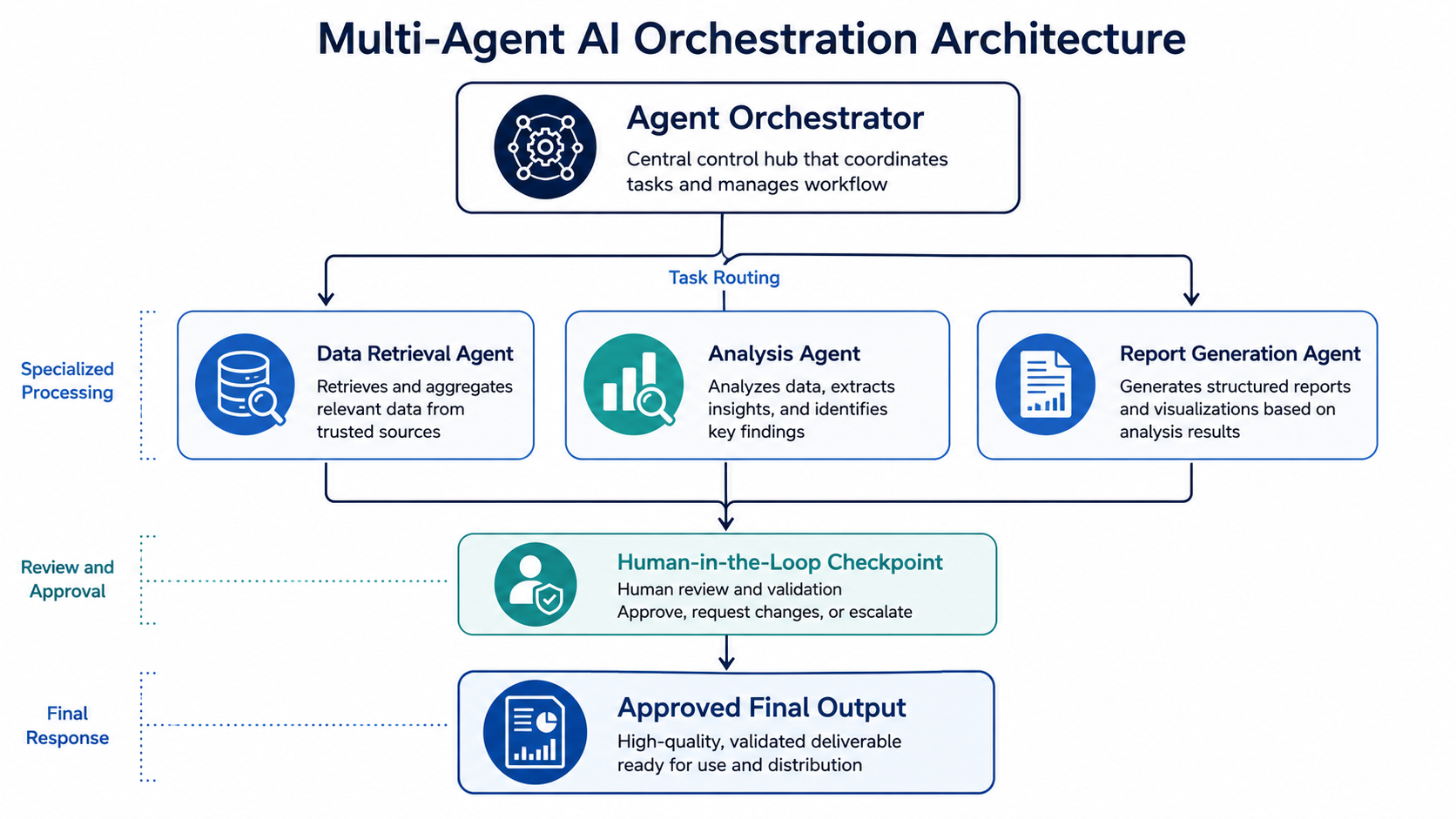 Multi-agent orchestration: an orchestrator routing work to three specialised sub-agents, with a human-in-the-loop checkpoint before high-stakes actions
The Four Architecture Decisions That Determine Success or Failure
1. Bounded Autonomy and Human-in-the-Loop Design
Before writing a single line of agent code, your team must answer: at what decision points does a human need to be in the loop? This is not a philosophical question — it is an infrastructure requirement that must be defined before architecture begins. Production agentic AI deployments rest on graduated authority models: routine, low-risk decisions execute automatically; medium-risk actions trigger human notifications; high-stakes decisions require explicit approval before execution.
Without these boundaries, agents either operate too conservatively (negating every automation benefit) or too aggressively (creating compliance and operational risk that surfaces after the fact). Design your approval workflows and escalation logic before building agent logic — not after you discover the agent auto-approved a vendor payment that required a finance director's sign-off.
2. Memory, State, and Context Management
Stateless models have no memory of what they decided three steps ago. An agent that cannot maintain context across a multi-step task is not autonomous — it is a single-turn chatbot running multiple API calls. Enterprise agentic systems manage memory at two levels: semantic memory (what the agent knows about the domain, stored as vector embeddings in a dedicated vector database) and episodic memory (what happened during the current task execution, stored as structured event logs).
In 2026, theModel Context Protocol (MCP)has become the de facto standard for how agents connect to both data stores and external tools. It provides a universal interface that replaces bespoke integration code for each new data source — significantly reducing development time and removing one of the historically largest sources of agentic system fragility.
3. Tool Orchestration and Multi-Agent Coordination
A single agent with a single tool is a workflow. A production agentic system has multiple specialized agents — each with bounded, explicitly defined tool access — coordinated by an orchestration layer that routes requests, monitors execution progress, manages error recovery, and ensures one agent's output flows correctly as another agent's input. Frameworks likeLangGraph andCrewAI provide orchestration primitives, but the architectural decision between a centralized control plane and a distributed mesh has long-term governance and debugging implications that go well beyond framework selection.
4. Governance, Security, and Observability
Only 21% of companies deploying agentic AI have a mature governance model, per Deloitte's 2026 data. This is the gap that generates the most expensive post-deployment problems. Security in agentic systems is not only about protecting the model — it is about what the agents can do with their tool access. An agent with database write permissions and insufficient scope controls can cause production data damage in seconds, with no easy audit trail if observability was not built in from the start.
The observability layer — logging agent decisions, intermediate reasoning steps, tool calls, inputs, and outputs — is what makes post-incident analysis possible, what compliance audit trails require, and what lets engineering teams improve agent performance based on real production data. Without it, debugging an agentic failure is forensically expensive.
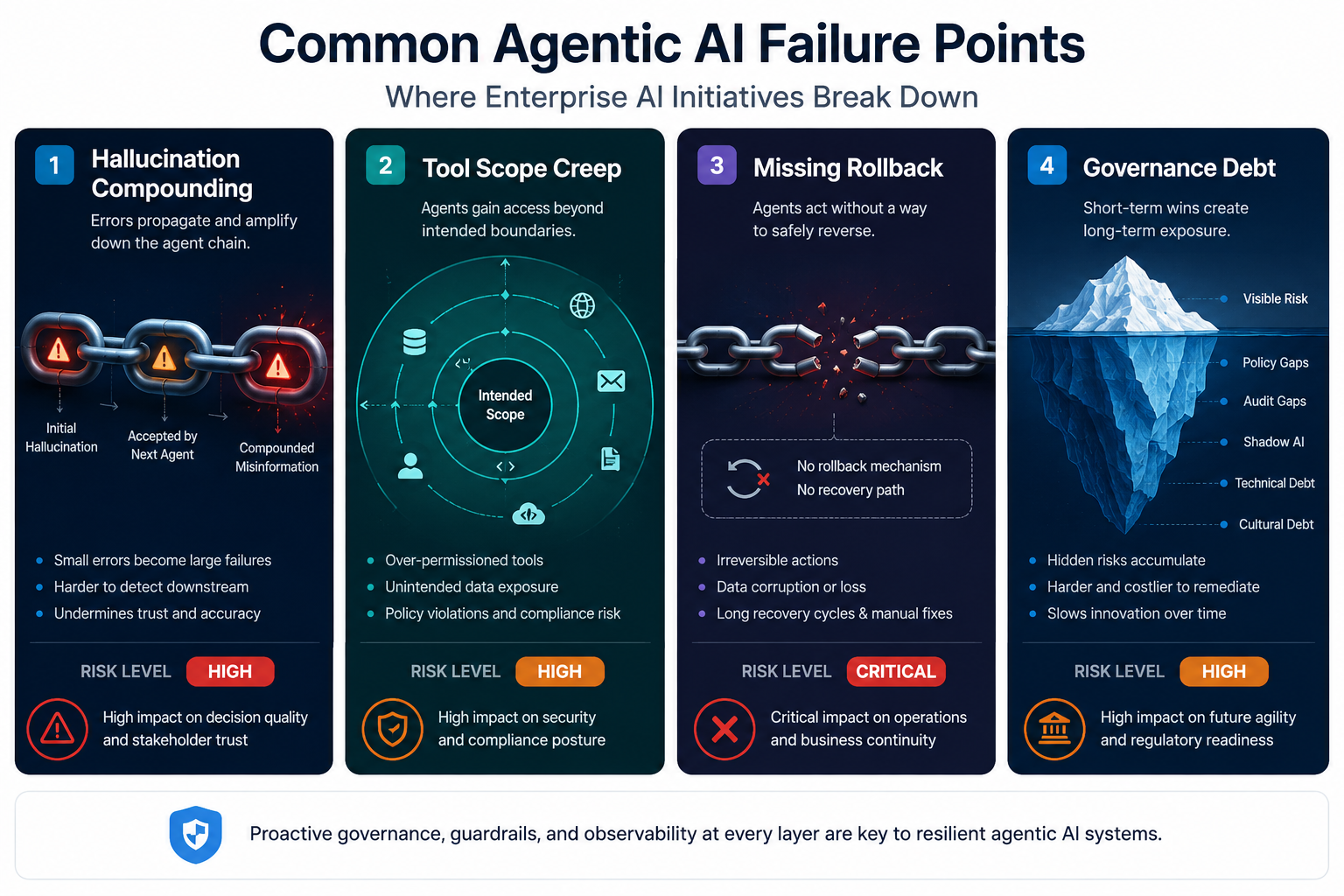 The four failure modes, each with its risk level: hallucination compounding, tool scope creep, missing rollback logic, and governance debt
The Four Failure Modes Quietly Sinking Enterprise AI Projects
After reviewing production deployments through 2025–2026, four failure patterns appear consistently.Kellton's enterprise AI architecture guide andKrapton's CTO playbookdocument the same patterns from their own client Independent enterpdeployments:
- Hallucination compounding — in multi-agent systems, one agent's confident wrong output becomes the next agent's authoritative input. A single hallucination propagates through three or four agent handoffs before a human sees a final output that looks internally consistent but is built on a false foundation.
- Tool scope creep — agents given broad tool access during development get deployed with those same permissions. A data-retrieval agent that can also write to production databases is a compliance risk disguised as engineering convenience.
- Missing rollback logic — when an agentic workflow partially fails mid-execution, what happens to the steps already completed? Without compensating transactions or rollback mechanisms, partial execution creates data inconsistencies that are expensive to diagnose and costly to resolve.
- Governance debt — organizations with mature change-management processes for traditional software skip governance frameworks for agents, treating them as “just another tool”. By the time the gap surfaces, it has usually generated meaningful compliance exposure or a costly audit finding.
Build vs Buy vs Partner: The Right Framework for 2026
The agentic AI platform market has matured significantly in 18 months, but not uniformly. Pure build-from-scratch makes sense only if your use case is genuinely novel, your engineering capacity is strong, and you have 12–18 months before you need to demonstrate ROI to leadership. For most enterprises, a partner-led approach is more economical: an experienced AI development partner designs and builds the initial production system, then transfers operational ownership to internal teams with documented architecture and runbooks. Multiple 2026 enterprise AI architecture analyses reach the same conclusion — experienced implementation partners can compress the production deployment timeline by 40–60% compared to internal greenfield builds.
The critical hiring or partner-selection question is not “which LLM do they use?” It is “how many production agentic AI systems have they built and deployed — not proof-of-concept systems, but live enterprise deployments with real transaction volumes?” That distinction separates the firms doing genuine AI engineering from those running extended PoCs at production-scale pricing. VeeTee's AI development practice focuses exclusively on production-grade enterprise deployments, with architecture design, security framework, observability setup, and knowledge transfer to internal teams built into every engagement.
The First 90 Days: A Practical Roadmap for CTOs
Days 1–30: Scope a single, high-value use case
Not your most complex use case — your most demonstrable one. Define bounded autonomy, map required tool access, identify approval workflows, and specify governance requirements before any agent architecture decisions are made.
Days 31–60: Build governance and observability first
Build governance and observability infrastructure before building agent logic. This sequence is counterintuitive for engineering teams but critical for enterprise deployments. Teams that build agent logic first and governance later almost universally retrofit inadequate controls that create audit risk.
Days 61–90: Deploy under full human oversight
Deploy to a non-critical production workflow under full human oversight. Measure actual performance against pre-defined targets. Adjust. Only then expand scope to higher-stakes workflows. The pilot that works under real conditions builds the organizational confidence that enables scale.
Conclusion
Agentic AI rewards the organizations that treat it as an infrastructure programme rather than a model selection exercise. Bounded autonomy, memory and state design, orchestration, and governance are the four decisions that separate systems that scale from pilots that stall — and all four are cheaper to get right before the first agent ships than to retrofit afterwards.
VeeTee'sAI and agentic development practicehas guided enterprises across the UAE, UK, USA, and India through this journey — from CTO briefing to production deployment. If you are also formalising the leadership structures behind the programme, our guide to building anAI leadership teamis a useful companion to this article.
Ready to build your enterprise agentic AI system — properly?
Schedule a free 45-minute AI architecture consultation with VeeTee Technologies— we specialise in production agentic AI development, from design to deployment.
Frequently Asked Questions (FAQ)
What is the difference between a chatbot and an agentic AI system?
What is the difference between a chatbot and an agentic AI system?
A chatbot processes one prompt and returns one response, then loses context. An agentic AI system maintains persistent state across multiple steps, adapts based on intermediate results, autonomously calls external tools and APIs, and can coordinate with other agents to complete complex multi-step tasks. The architectural requirements — memory management, orchestration layers, rollback logic, observability — are fundamentally different from a prompt-response system. The practical difference: a chatbot can answer “what is our Q3 revenue?” An agentic system can autonomously pull Q3 data, compare it to budget, identify the three largest variances, draft an explanation narrative, and flag the result for CFO review — without step-by-step human instruction.
How long does it take to build a production agentic AI system?
How long does it take to build a production agentic AI system?
A well-scoped first use case — with clear bounded autonomy, defined tool access, mapped approval workflows, governance setup, observability, security controls, and team knowledge transfer — typically reaches production in 12 to 20 weeks (roughly 90–120 days) with an experienced development partner. Broader multi-agent systems with full ERP integration and cross-department workflows typically require 6–12 months for initial production deployment. Timelines expand when master data quality is poor, when the use case involves multiple system integrations, or when governance requirements are complex, as in regulated industries. Proof-of-concept builds take only 4–6 weeks — and the gap between a PoC and a production-grade system is where most enterprise AI projects stall.
What is the Model Context Protocol (MCP) and why does it matter?
What is the Model Context Protocol (MCP) and why does it matter?
The Model Context Protocol is an open standard — originally developed by Anthropic — defining how AI agents connect to external tools, data stores, databases, and APIs. Before MCP, every integration between an agent and a data source required bespoke code. With MCP, a compatible agent can connect to any MCP-compliant tool or data source through a standard interface. In 2026 it has become the de facto universal interface for enterprise agentic systems: most major enterprise data platforms and SaaS tools have published MCP connectors. It significantly reduces integration development time, improves system portability across agent frameworks, and simplifies security auditing of agent tool access.
How do you prevent hallucination errors from spreading through multi-agent pipelines?
How do you prevent hallucination errors from spreading through multi-agent pipelines?
The primary defences are: human-in-the-loop checkpoints at high-stakes decision nodes before outputs become inputs; output validation at agent handoff points using structured output schemas with type checking rather than free text; confidence scoring that flags low-confidence outputs for human review before they become inputs to downstream agents; grounding mechanisms requiring agents to cite retrievable sources for factual claims; and statistical monitoring that flags anomalies in agent output distributions for human review. Architectures that require agents to justify decisions rather than just produce outputs have significantly lower propagation rates. No combination of these eliminates hallucination entirely — that remains an active research problem. What they do is prevent a single hallucination from propagating silently through three or four agent steps before a human sees the final output.
Is agentic AI suitable for regulated industries like banking or healthcare?
Is agentic AI suitable for regulated industries like banking or healthcare?
Agentic AI is deployable in regulated industries, but governance requirements are significantly higher. This means fine-grained audit trails of every agent decision and tool call, explainability mechanisms that document the reasoning behind each action, human-in-the-loop controls at all high-stakes decision points, and formal security reviews of every tool an agent can access. Regulated-industry deployments benefit most from experienced partners who have managed compliance requirements in production environments, not just in pre-sales proof-of-concept contexts.
What is the first agentic AI use case most enterprises should prioritise?
What is the first agentic AI use case most enterprises should prioritise?
The best first use case is high in frequency, low in irreversibility, and unambiguous in how success is measured — not the most complex thing you eventually want to build. Common strong starting points include document processing, analysis and summarisation (contract review, invoice processing, compliance checking), invoice matching and exception flagging, sales call summarisation with CRM update, customer support triage that routes and classifies before human escalation, and internal knowledge base agents that search and synthesise across structured data sources. They run frequently enough to generate useful production data quickly, have low downside if the agent makes a mistake, and have clear metrics — accuracy rate, processing time, human review rate — that let you demonstrate ROI before expanding scope. They also let teams develop governance and observability infrastructure on lower-stakes workflows before deploying to mission-critical systems.
Get in Touch
Contact Us
+91 9500945700
adm@vttech.in
No: 8/65, 1st Floor, Radhakrishnan Street, Shankaran Avenue, Velachery, Chennai, Tamil Nadu – 600042, India.
We’re here to help you !