SAP Integration in the UAE: What CIOs Need to Get Right Before Choosing an Implementation Partner
Last Updated : 02/09/2026
Estimated : 15 min read
Author : Lokesh A

Table of Content
- The Problem Nobody Warns You About
- What Is SAP Integration, Really?
- Why UAE Businesses Can't Ignore This Right Now
- The "3 Months Later" Problem — How These Projects Actually Fail
- SAP's Modern Approach, Explained Simply
- The SAP Deadline That Changes Your Integration Plan
- SAP Business One vs S/4HANA: Which Integration Path Fits You?
- What to Ask Before You Choose an Integration Partner
- A Realistic Example
- What's Coming Next
- Frequently Asked Questions
- The Bottom Line
The Problem Nobody Warns You About
Here's a pattern we see again and again with SAP integration projects in the UAE.
The project starts well. The consultants are sharp. The go-live date is met. Everyone shakes hands and moves on.
Then, three months later, someone in finance is still manually copying numbers from SAP into a spreadsheet, then into another system, because one small connection was never quite finished. It was supposed to be temporary. A short-term fix while the "real" integration got built later.
That "later" never comes. The manual workaround becomes the permanent process. Nobody owns it. Nobody trusts the numbers fully. And when the UAE's new digital tax rules arrive — which, as you'll see below, they already are — that shaky manual step becomes a real business risk.
This article explains, in plain language, what SAP integration actually means, why it matters more in the UAE right now than it did even a year ago, and exactly what to check before you choose someone to do it for you.
What Is SAP Integration, Really?
Let's strip away the jargon for a second.
SAP is a big software system many companies use to run their business — things like finance, inventory, purchasing, and payroll all live inside it.
But no company runs on SAP alone. You probably also use a banking system, a CRM for sales, an e-commerce platform, maybe a separate HR tool, and now, increasingly, a government tax system too.
SAP integration simply means connecting SAP to all of those other systems, so information flows automatically between them — instead of a person retyping it by hand.
Think of it like plumbing in a house. You don't see it once it's installed properly. Water just flows where it needs to go. But bad plumbing — a pipe that's not quite connected — doesn't fail immediately. It leaks slowly, quietly, until one day it's a real problem.
That's exactly what a half-finished SAP integration looks like.
Why UAE Businesses Can't Ignore This Right Now
This is not a "someday" topic. Two real, dated changes are already reshaping how UAE businesses must connect their SAP systems to the outside world.
1. UAE e-invoicing is no longer a future plan — it's already starting.
The UAE government has confirmed a phased rollout of mandatory electronic invoicing, built on a Peppol-based network (a common international standard for exchanging invoices electronically), under Ministerial Decisions No. 243 and 244 of 2025 (source:KPMG, UAE technical guidance on mandatory e-invoicing fields).
Here's the actual timeline:
| Phase | Who it affects | Provider must be appointed by | Mandatory from |
|---|---|---|---|
| Pilot / voluntary | Any business that opts in | — | 1 July 2026 — already live |
| Phase 1 | Businesses earning AED 50 million+ a year | 30 October 2026 | 1 January 2027 |
| Phase 2 | Businesses earning under AED 50 million | 31 March 2027 | 1 July 2027 |
| Phase 3 | Government entities | 31 March 2027 | 1 October 2027 |
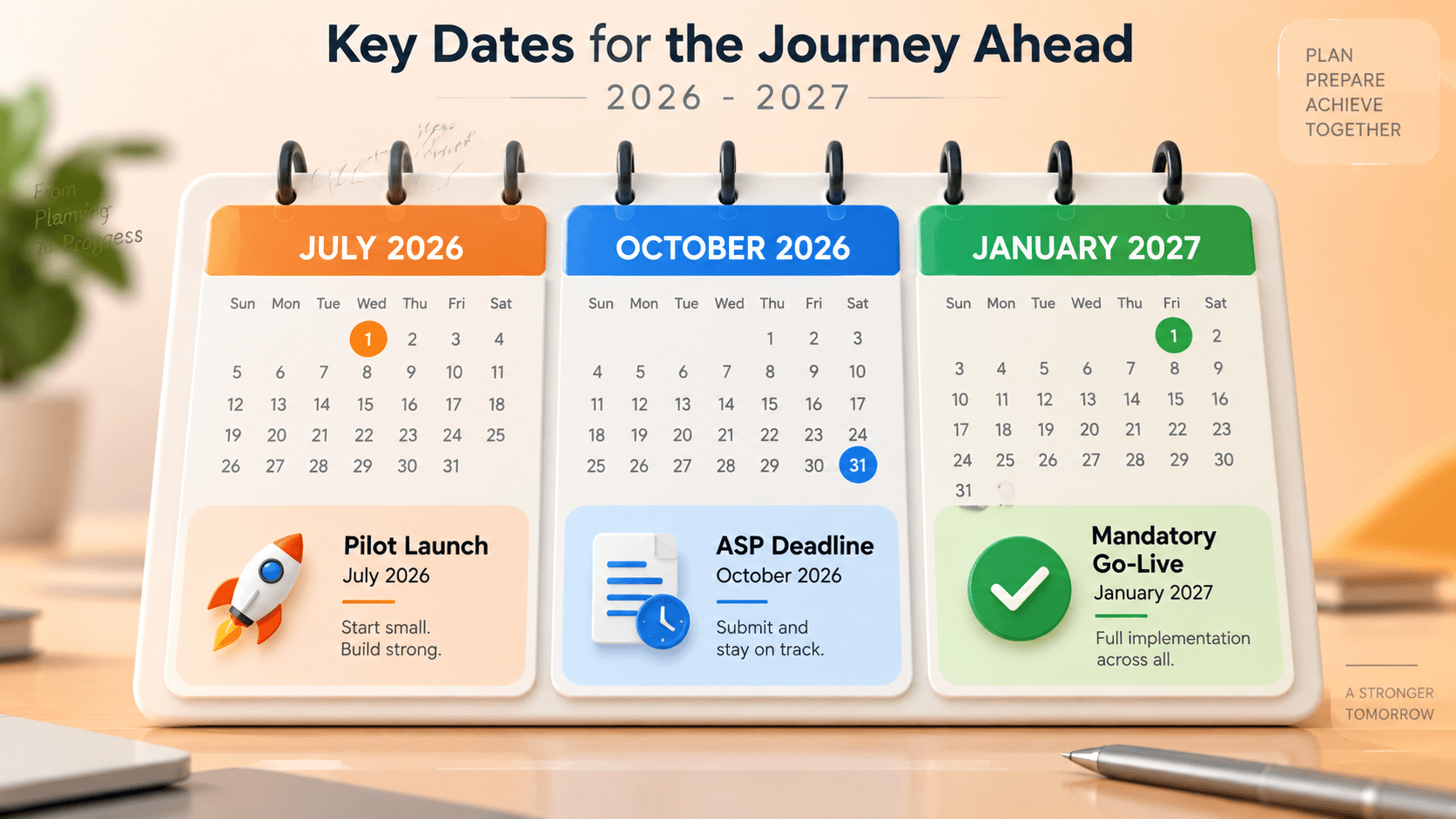 UAE e-invoicing timeline: pilot launch (July 2026), provider deadline (October 2026), mandatory go-live (January 2027)
In plain words: if your business earns AED 50 million or more a year, you have until the end of October 2026 to have an accredited invoicing provider connected to your systems — and that provider needs to talk directly to SAP. SAP itself won't do this for you automatically. Someone has to build that connection, correctly, in a system that already generates thousands of invoices.
2. UAE Corporate Tax deadlines are landing right now, not later.
If your company's financial year ended 31 December 2025, your Corporate Tax return is due 30 September 2026 — which, if you're reading this in early September, is only weeks away (source:Corcess, UAE Corporate Tax & E-Invoicing Deadlines 2026). Late filing carries a fine of AED 500 per month for the first year, rising to AED 1,000 per month after that.
Both of these rules point to the same conclusion. Your SAP system needs to talk cleanly and automatically to your tax and invoicing processes. And it needs to happen right now — not in some future "phase two" project.
The "3 Months Later" Problem — How These Projects Actually Fail
Almost no SAP integration project fails on day one. They fail slowly, in one of these four ways:
- The "temporary" manual step becomes permanent. A connection between SAP and, say, a banking system is left half-built because of a deadline. Everyone agrees to "fix it after go-live." It never gets fixed, because there's always a new priority.
- Nobody owns the integration after the consultants leave. Many integration projects are treated as a one-time task, not an ongoing responsibility. Say a bank changes its file format six months later. Something breaks. There's no one whose job it is to notice, let alone fix it.
- The middleware choice doesn't match the company's real needs. SAP offers several ways to connect systems. Choosing the wrong one for your size and complexity either costs far more than needed, or breaks down as you grow.
- Data isn't checked, just moved. Fast integrations sometimes skip proper validation — checking that a number, a tax code, or a customer ID is actually correct before it moves between systems. Bad data moving faster is still bad data.
SAP's Modern Approach, Explained Simply
If you've researched this before, you may have come across older terms like SAP PI or SAP PO. These are still in use in many companies. But SAP's current recommended approach is called the SAP Integration Suite. It's part of a larger platform called SAP BTP (Business Technology Platform).
You don't need to memorise the acronyms. Here's what actually matters:
- It's built to connect SAP with cloud systems, not just other SAP products — useful when you're also using a bank's API, a government tax portal, or a CRM like Salesforce.
- It's designed to be more visual and manageable than older tools, meaning your IT team (or your integration partner) can see and fix problems faster.
- SAP is actively investing in this platform, which matters because it's less likely to be discontinued or left unsupported in the coming years — unlike some older integration tools.
Our own team has written a deeper technical walkthrough of this if you want to go further:A Complete Guide to the SAP Integration Suite.
The SAP Deadline That Changes Your Integration Plan
Here's a fact that changes how you should think about SAP integration decisions in 2026, even if you're not planning a full system replacement.
SAP has confirmed that mainstream maintenance for SAP ECC ends on 31 December 2027 — with no further extensions. After that date, ECC systems will keep running. But SAP stops providing new security patches, legal updates, and bug fixes for the core system. You can pay extra for "Extended Maintenance" to keep some support until 2030. That option costs roughly 2–4% more on top of your normal annual maintenance fee (source:Seidor, Understanding SAP ECC Deadlines;SAVIC Technologies, ECC End of Maintenance 2027).
To put this in perspective: industry estimates suggest roughly 85% of SAP's installed base is still running ECC. And a move to the newer S/4HANA system isn't quick. It typically takes 12 to 24 months for a mid-sized company, and up to 36 months for a large one (source:SAVIC Technologies, "60%+ of Companies Haven't Started Migration").
Why does this matter for an integration project you're planning today? Say you build a brand-new integration on top of ECC in 2026. If your company then migrates to S/4HANA in 2027 or 2028, you may need to rebuild significant parts of it again. A good integration partner should ask about your S/4HANA timeline before recommending an architecture — not after.
If your organisation hasn't started planning this migration, look at our guide on theOracle Discoverer migration. It shows the kind of structured, zero-downtime planning that applies just as well to a SAP S/4HANA move.
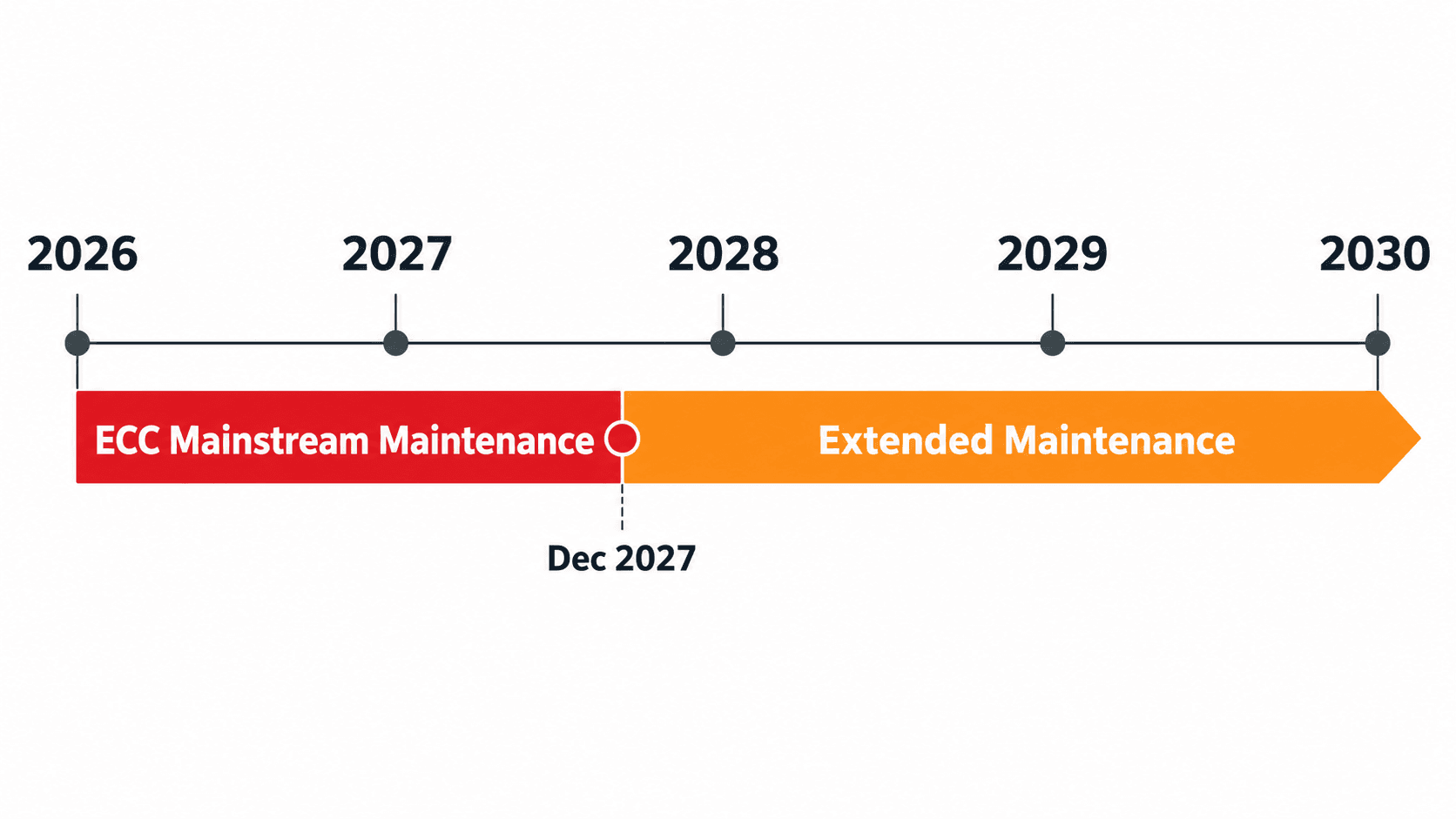 SAP ECC timeline: mainstream maintenance ends 31 December 2027, optional Extended Maintenance runs to 2030
SAP Business One vs S/4HANA: Which Integration Path Fits You?
Not every UAE business runs full S/4HANA. Many small and mid-sized companies run SAP Business One (SAP B1), a lighter version built for smaller operations.
- If you're on SAP B1, your integration needs are usually simpler — connecting to a bank, an e-commerce store, or a CRM. The e-invoicing requirement still applies to you (once your revenue crosses the relevant threshold), so this shouldn't be ignored just because your system is smaller.
- If you're on SAP ECC or S/4HANA, your integration complexity is usually higher — more departments, more custom processes, and a bigger e-invoicing footprint (higher invoice volumes mean more room for errors to hide).
Either way, the underlying question is the same: does the data flow correctly, automatically, and get checked properly — every single time, not just during testing?
What to Ask Before You Choose an Integration Partner
Use this as a practical checklist in your next vendor conversation.
- "Who owns this integration after go-live — and what does that ongoing support actually include?" A vague answer here is a warning sign.
- "How will this integration handle the UAE e-invoicing requirement, specifically?" If they can't answer this clearly for your business size and revenue bracket, they haven't done their homework.
- "Are you building this on SAP Integration Suite, or an older tool?" Older tools aren't automatically wrong, but you should know which one you're getting, and why.
- "What happens to this integration if we move to S/4HANA next year?" A good partner has a real answer. A vendor just trying to close the deal often doesn't.
- "Can you show me a similar integration you've built and supported for more than 12 months?" Anyone can build something that works on day one. Ask about day 200.
- "What's your data validation process — how do you catch a wrong tax code or duplicate invoice before it moves between systems?"
VeeTee Technologieshas spent 17 years doing exactly this kind of implementation work acrossOracle, SAP, and cloud platforms for clients across India, the UAE, the UK, and beyond — you're welcome to ask us every one of these six questions directly.
A Realistic Example
Picture a mid-sized trading company in Dubai, moving goods between three warehouses and selling both online and to retail partners.
Their SAP system tracked inventory and finance correctly. But when a sale happened, someone in finance still had to help. They manually re-entered the invoice details into a separate accounting tool used for VAT filing. It was a "temporary" step from two years earlier that never got automated.
With UAE e-invoicing now requiring invoices to move through an accredited provider automatically, that manual step wasn't just inefficient anymore. It was a genuine compliance risk. Fixing the SAP integration properly meant the invoice, the tax code, and the provider hand-off all happened in one automatic flow. A validation check caught mismatched tax IDs before they became a filing problem.
The technical work took a few weeks. The two years of manual risk it removed is the part that actually mattered.
What's Coming Next
A few developments worth watching as you plan your own SAP integration roadmap:
E-invoicing will expand beyond the UAE's current phases. Once the AED 50 million threshold phase is live from January 2027, expect enforcement and scrutiny to increase, not decrease, as the Federal Tax Authority gathers more real-time data.
SAP is investing heavily in AI-assisted integration monitoring. Newer tools within the SAP BTP ecosystem are increasingly able to flag unusual data patterns automatically — for example, spotting an invoice that doesn't match a normal pattern — rather than waiting for a human to notice a problem weeks later.
The gap between "SAP users" and "SAP integration-ready businesses" will widen. More regulatory requirements keep plugging directly into ERP systems. Businesses with clean, well-maintained integrations will simply move faster. For them, a new compliance rule becomes a configuration change, not a crisis project.
Frequently Asked Questions
It means connecting your SAP system to other software. That could be your bank, your CRM, or a government tax system. Information then moves between them automatically, without someone re-typing it by hand.
Yes, eventually. Businesses earning AED 50 million or more must comply from 1 January 2027. Businesses below that threshold follow from 1 July 2027. There is no full exemption for size — only a later start date.
No. You can and should integrate your current SAP system now. The key is making sure your integration partner designs it in a way that won't need a full rebuild if and when you do migrate.
The exact fines are still being finalised by the UAE Federal Tax Authority as the mandate rolls out. But being late or non-compliant already carries real financial penalties under UAE tax law. On top of that, compliant trading partners may simply reject your invoices.
Not exactly — SAP Integration Suite is one part (a set of tools) within the broader SAP BTP platform, which also includes other services like application development and analytics.
It depends heavily on complexity, but a focused integration project (for example, connecting SAP to an e-invoicing provider) typically takes a few weeks to a few months, while a full S/4HANA migration with integration can take 12 months or more.
The Bottom Line
SAP integration in the UAE has quietly moved from "nice to have" to "regulatory necessity" in the space of about a year. The e-invoicing pilot is already live. The mandatory phases are dated and confirmed. And the SAP ECC deadline means every integration decision you make now should be built with tomorrow's system in mind, not just today's.
Get the connections right, get them owned by someone after go-live, and get them validated — and every new compliance deadline becomes routine, not a fire drill.
Schedule a free SAP integration scoping call with VeeTee's UAE team.Get in touch hereor explore ourSAP Integration servicesin detail.
Related Reading on the VeeTee Blog
External Sources Referenced in This Article
- KPMG —UAE technical guidance: mandatory e-invoicing fields
- Incorporate UAE —UAE E-Invoicing 2026: Timeline, Scope and Penalties
- Corcess —UAE Corporate Tax & E-Invoicing Deadlines 2026
- Seidor —Understanding SAP ECC Deadlines: What 2026 and 2027 Mean for Your Business
- SAVIC Technologies —ECC End of Maintenance: Why 2027 Is the Deadline Every SAP Customer Must Respect
This article reflects publicly available regulatory information as of September 2026. UAE tax and e-invoicing rules are still being finalised in places — always confirm current requirements with the UAE Federal Tax Authority or a qualified tax advisor before making compliance decisions.
Get in Touch
Contact Us
+91 9500945700
adm@vttech.in
No: 8/65, 1st Floor, Radhakrishnan Street, Shankaran Avenue, Velachery, Chennai, Tamil Nadu – 600042, India.
We’re here to help you !