In-House vs Outsourced Oracle DBA: The Real Cost Comparison Enterprises Get Wrong in 2026
Last Updated : 04/09/2026
Estimated : 14 min read
Author : Lokesh A
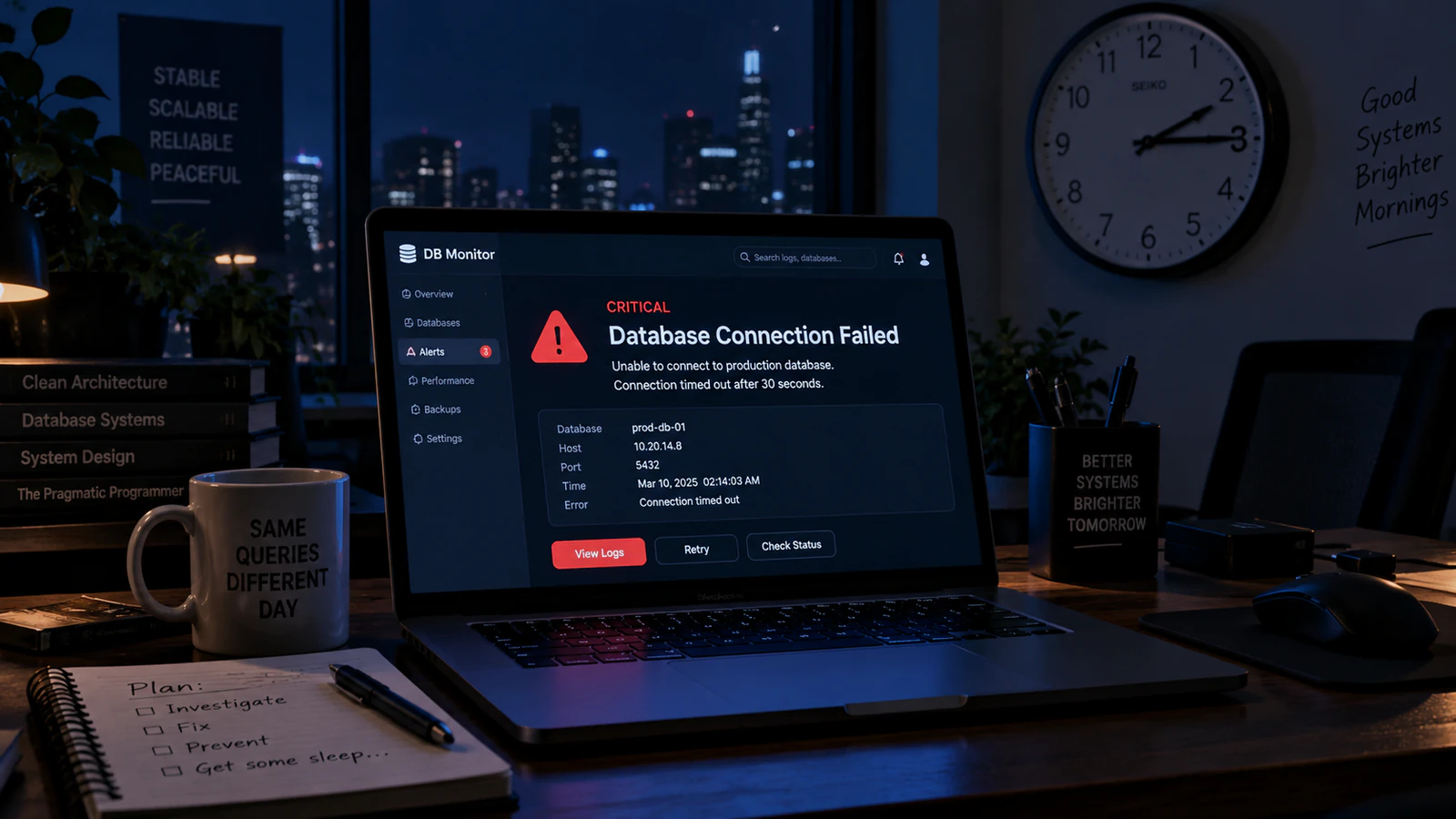
Table of Content
- The 2 a.m. Question Every IT Director Eventually Asks
- What Does an Oracle DBA Actually Do?
- The Real Cost of an In-House Oracle DBA
- The Hidden Costs Nobody Counts
- What Outsourced or Remote Oracle DBA Support Actually Looks Like
- When Outsourcing Goes Wrong — What to Watch For
- A Simple Decision Framework
- A Realistic Example
- What's Coming Next
- Frequently Asked Questions
- The Bottom Line
The 2 a.m. Question Every IT Director Eventually Asks
It's 2 a.m. Your company's Oracle database — the one holding every customer order, every invoice, every record your business runs on — throws an error nobody expects.
Now ask yourself honestly: who is awake, right now, who actually knows how to fix this?
For a lot of companies, the honest answer is "nobody, until morning." For others, it's "one person — and if they don't pick up the phone, we're stuck."
This single question is really what the "in-house vs outsourced Oracle DBA" decision comes down to. Not brand loyalty. Not a general preference for keeping things "in the family." Just one plain question: who is actually there when the database breaks, and what does it cost to make sure someone always is?
This article walks through the real numbers, in plain language, so you can answer that question for your own business.
What Does an Oracle DBA Actually Do?
Let's start simple. DBA stands for Database Administrator. Their job is to keep a company's database — think of it as a giant, extremely organised filing cabinet holding all your business data — safe, fast, and always available.
A good Oracle DBA does things like:
- Takes regular backups, so if something goes wrong, you don't lose your data.
- Watches performance, so the system doesn't slow to a crawl as your business grows.
- Applies security patches, closing holes that hackers could otherwise use.
- Plans for disasters — what happens if a server fails, or a data center loses power.
- Fixes problems fast when something breaks, ideally before customers even notice.
If this sounds like a job that needs someone awake and available most of the time — you're already seeing the core of this decision.
The Real Cost of an In-House Oracle DBA
Let's look at real salary numbers, not guesses.
As of August 2026, the average annual salary for an Oracle Database Administrator in the United States is $118,548, with most falling between $101,500 and $138,000 depending on experience — and the most experienced specialists earning $156,500 or more (source:ZipRecruiter, Oracle DBA Salary). A Senior Oracle DBA averages $129,452 a year (source:ZipRecruiter, Senior Oracle Database Administrator Salary).
But here's the number that catches most companies off guard: that salary is not the real cost of hiring someone.
On top of base salary, a business typically also pays for:
- Payroll taxes and statutory contributions
- Health insurance and other benefits
- Laptop, software licenses, and monitoring tools
- Recruitment costs (agency fees, time spent interviewing)
- Ongoing training, since Oracle technology keeps changing
- Paid leave and holidays — time when, remember, nobody is covering the database
When you add all of this up, HR and finance teams commonly find that the true cost of an employee runs well above their listed salary — often by a meaningful margin once every hidden line item is counted, not just the number printed on the offer letter.
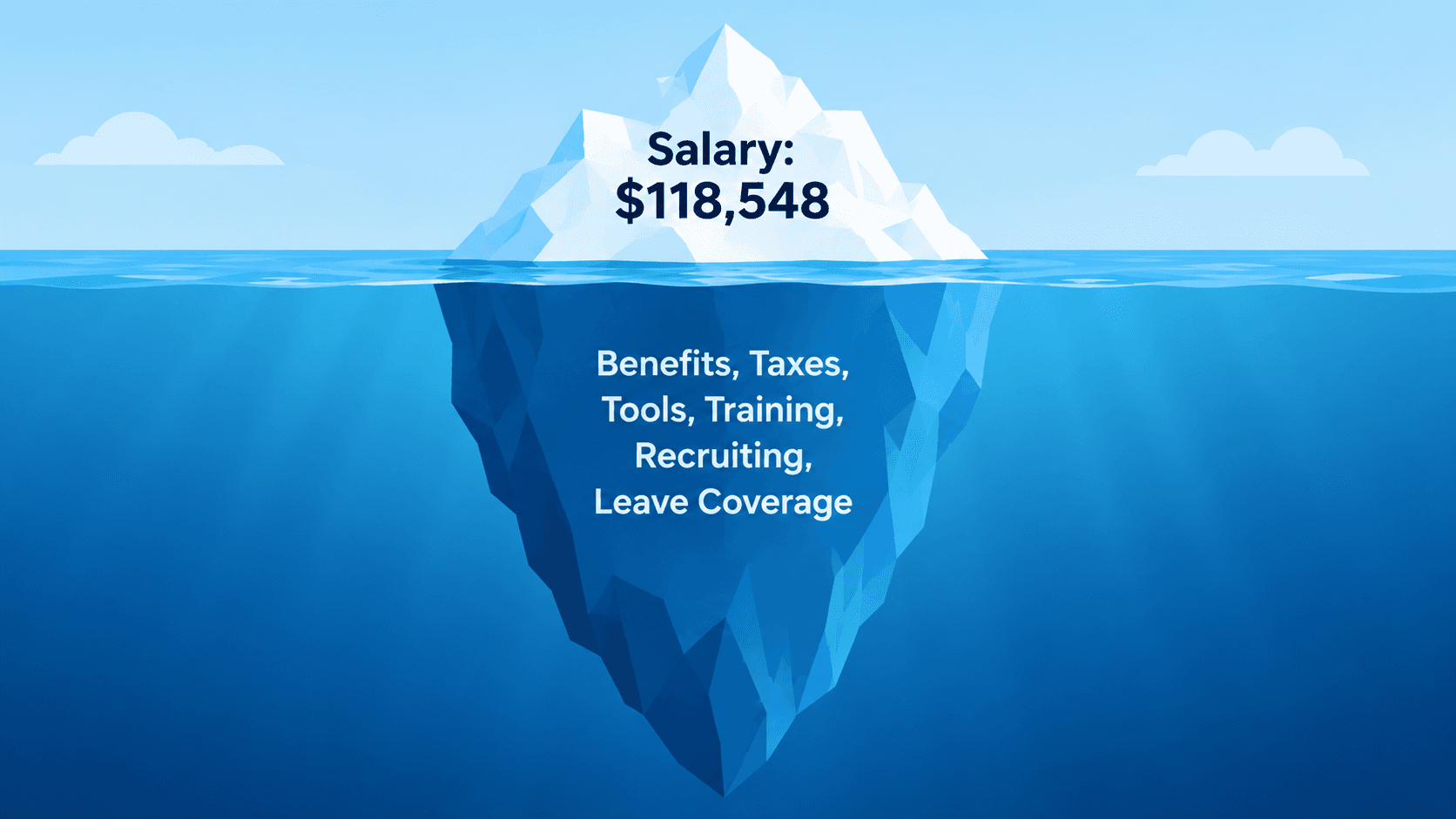 The salary is only the tip: benefits, taxes, tools, training, recruiting and leave coverage sit below the waterline
The Hidden Costs Nobody Counts
Salary math is only half the story. Here's what usually gets left out entirely.
- One person is a single point of failure. If your only Oracle DBA is on holiday, sick, or simply asleep at 2 a.m., who handles an emergency? Many companies quietly accept this risk because hiring a second, backup DBA feels too expensive — without realising the risk itself has a real cost too.
- Real downtime is expensive — often shockingly so. Widely cited industry benchmarks put the average cost of IT downtime at roughly $5,600 per minute — about $336,000 per hour — across industries. More recent surveys go even further. Over 90% of mid-size and large enterprises now say an hour of downtime costs them more than $300,000 (source:OutageCost.com, aggregating Gartner and ITIC benchmarks). Even if your business is smaller than that, the direction of the number should worry you. An unavailable database is never a "small" problem.
- Recruiting and replacing a DBA takes time you don't get back. Skilled Oracle DBAs are not easy to find quickly. If your one in-house DBA resigns, you may spend weeks or months with reduced coverage while you search for a replacement. And Oracle expertise doesn't transfer instantly to a new hire, even a good one.
- Round-the-clock coverage effectively means hiring more than one person. A single employee cannot reasonably provide genuine 24/7 coverage alone, forever, without burning out. True around-the-clock in-house coverage usually means at least two or three people, splitting shifts — which multiplies every cost above.
What Outsourced or Remote Oracle DBA Support Actually Looks Like
Outsourced Oracle DBA support means hiring a specialist company — rather than a single employee — to manage your database, typically for a predictable monthly fee.
Done well, this usually includes:
- A team, not one person. If someone is unavailable, someone else on the team already knows your systems.
- 24/7 monitoring, so a problem is often caught and fixed before your own staff even notice it.
- Broader experience, since the team works across many different companies' databases, not just yours — meaning they've likely already seen and solved your specific problem before.
- Predictable monthly cost, instead of an unpredictable emergency bill or a large fixed salary regardless of how busy the database actually is.
This is exactly the model behindVeeTee'sOracle Database Support services. It includes ongoing monitoring, backup management, performance tuning, and upgrade support — backed by a full team rather than a single hire.
If you're specifically dealing with an ageing, unsupported reporting tool, our guide on theOracle 23ai zero-downtime upgradeshows what a properly resourced Oracle team can achieve without service interruption.
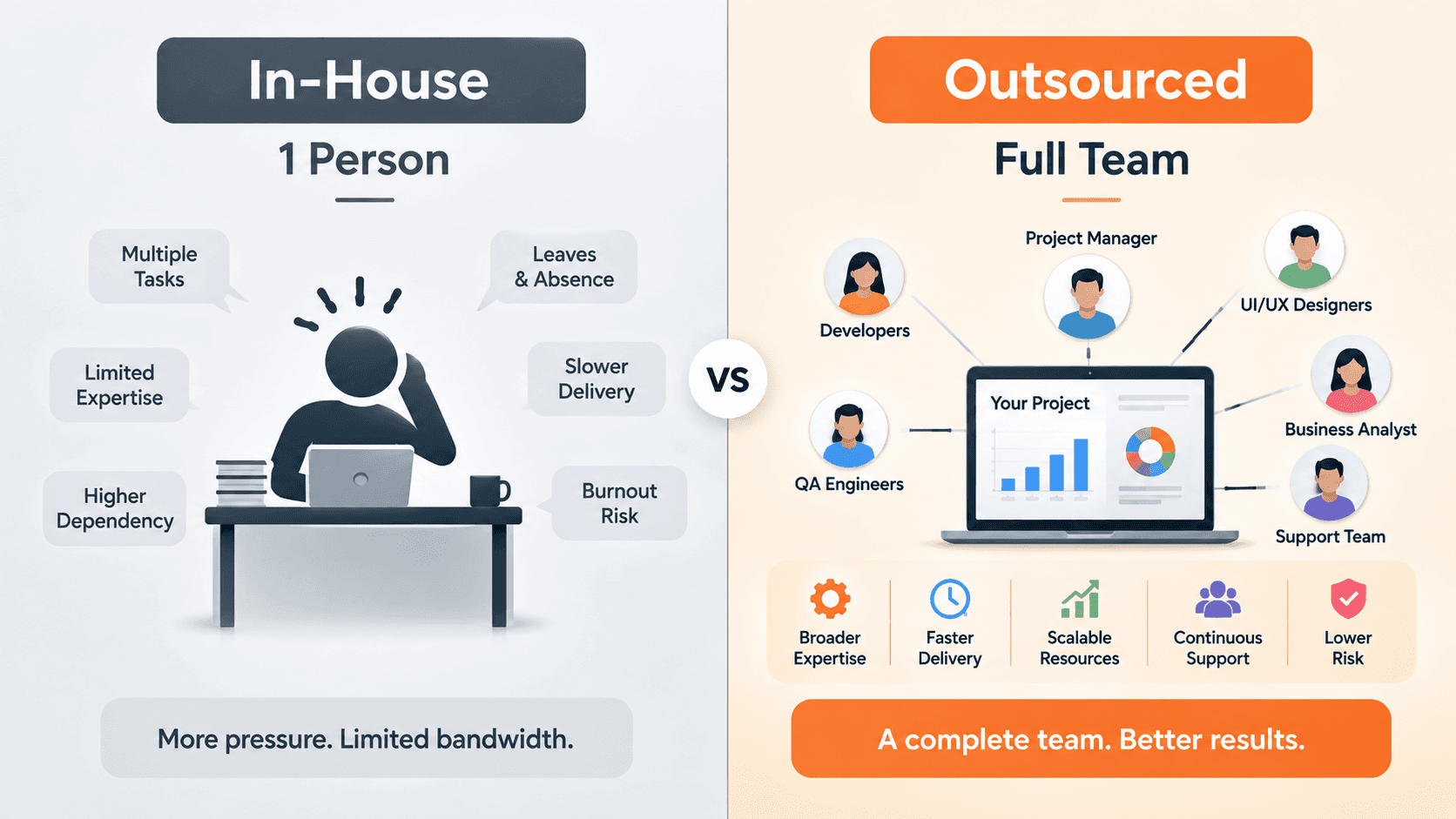 One in-house DBA versus an outsourced team working from a shared 24/7 monitoring dashboard
When Outsourcing Goes Wrong — What to Watch For
To be fair and balanced here: outsourcing isn't automatically better if it's done badly. These are the real warning signs.
Vague response-time promises. "We'll get to it quickly" is not a commitment. Ask for a specific, written response time for critical issues — for example, "critical issues acknowledged within 15 minutes, 24/7."
No named team, just a ticket queue. Say you never know who's actually handling your database, and every issue starts from zero with a new person. Then you lose the "they already know our systems" advantage that outsourcing is supposed to provide.
Pure "break-fix" support with no proactive monitoring. A provider who only shows up after something breaks isn't really preventing the 2 a.m. call — they're just answering it, after the damage is already done.
Providers who specialise only in Oracle databases, with nothing else. This isn't automatically bad. But think about it this way: your database problem might actually be connected to your application, or your cloud setup. If so, you may need a second vendor anyway. That undoes some of the simplicity outsourcing was supposed to bring.
A Simple Decision Framework
Ask yourself these questions honestly:
- Can we truly staff 24/7 coverage with our current team, without burning someone out? If the honest answer is no, in-house-only coverage has a real, uncounted risk attached to it.
- How many hours could our business survive a database outage before it seriously hurts revenue or customers? If the answer is "not many," speed of response should be your top priority in this decision — not just headline cost.
- Do we have more than one person who could step in if our current DBA left tomorrow? If not, you already have a single point of failure, whether or not you've labelled it that way.
- Is our database workload growing, shrinking, or staying flat? A fixed in-house salary doesn't flex with your workload. A managed service usually can.
- Do we need Oracle expertise only, or do we also need help with the applications and cloud systems around it? If it's the latter, a broader technology partner — not just a DBA-only specialist — may genuinely save you a second vendor relationship.
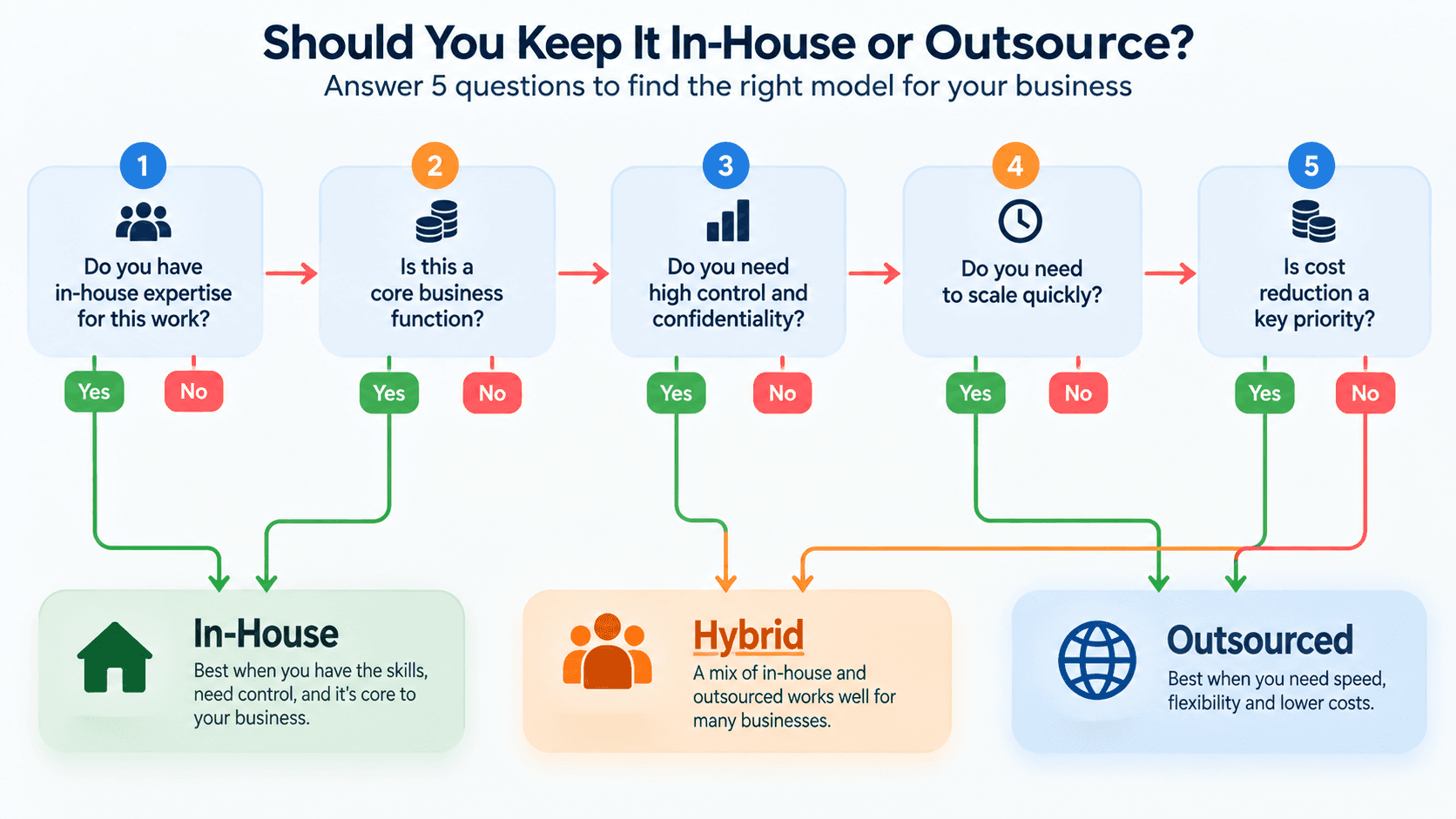 Five questions that point to an in-house, outsourced or hybrid Oracle DBA model
Many mid-sized companies land on a hybrid answer. A smaller in-house team handles day-to-day requests. An outsourced partner covers 24/7 monitoring, emergency response, and big upgrade projects. That way, you get the best of both. And you're not paying for round-the-clock in-house staff that a single company rarely needs on its own.
A Realistic Example
Picture a mid-sized logistics company running a critical Oracle database that tracks shipments and billing around the clock, across multiple time zones.
For years, they relied on a single in-house DBA — skilled, but one person. When he took a two-week holiday, the company quietly held its breath, hoping nothing went wrong. Once, something did: a performance issue slowed order processing for several hours before he was reachable.
After moving to a managed Oracle support model, the company kept a smaller in-house presence for daily requests, while a dedicated support team handled 24/7 monitoring and emergency response. The next time a similar performance issue appeared, it was caught and resolved within minutes, overnight, before a single customer noticed — and without anyone's holiday being interrupted.
The company's Oracle costs didn't dramatically increase. What changed was that the risk of a single person being unavailable stopped being something they simply hoped wouldn't happen.
What's Coming Next
A few shifts worth watching as this decision keeps evolving:
Oracle's own database is getting smarter, not simpler to ignore. Oracle 23ai introduces AI-driven features like built-in vector search and more automated tuning. These are genuinely useful. But they also mean DBA teams need to keep learning continuously, just to use the platform's own new capabilities well. Falling behind on this widens the gap between well-supported and poorly-supported databases.
"Autonomous" doesn't mean "unattended." Oracle continues to expand automation in areas like patching and tuning, but automation still needs oversight — someone has to configure it correctly, monitor its decisions, and step in when an edge case appears that automation doesn't handle well.
The DBA talent market is only getting tighter. As more companies delay hiring decisions and lean on existing staff, experienced Oracle DBAs remain in short supply — which tends to push in-house salaries up over time, while well-run outsourced teams can spread that same expertise across many clients at once.
Frequently Asked Questions
It depends on your specific needs. But outsourcing is often more cost-effective for round-the-clock coverage specifically. That's because you're sharing a team's cost across many clients, rather than paying multiple full-time salaries for your business alone.
In the United States, the average is around $118,548 a year for a standard role, and about $129,452 for a senior DBA. Remember, this is base salary only — before benefits, tools, and other employment costs are added.
Yes, if your database supports customer orders, billing, or any process that can't simply wait until morning. The size of your company matters less than how critical and time-sensitive your database actually is.
At minimum, ask three things. What's their written response-time guarantee for critical issues? Do you get a named team, or an anonymous ticket queue? And do they offer proactive monitoring, or only respond after something breaks?
No — with a properly structured agreement, you retain ownership and access to your own systems. The provider manages the day-to-day technical work under terms you set, not the other way around.
Yes, it's increasingly the norm for mid-sized companies: a smaller internal team for daily needs, with an outsourced partner covering nights, weekends, and specialist projects like major upgrades.
The Bottom Line
The real in-house vs outsourced Oracle DBA decision was never just about salary. It's about who's actually there at 2 a.m. It's about what a single point of failure is quietly costing you in risk. And it's about whether your current setup can really survive one person being unavailable at the wrong moment.
Do the honest math — full cost, real coverage, real risk — and the right answer usually becomes clear.
Get a free Oracle environment health check from VeeTee's DBA team.Schedule a consultationor explore ourOracle Database Support servicesin detail.
Related Reading on the VeeTee Blog
- Why Should Business Leaders Prioritize Oracle Database Support Services Today?
- Oracle Database Upgrade to 23ai: The Zero-Downtime Guide for DBAs
- A Complete Guide to Application Support and Maintenance for Future-Ready Enterprises
- IT Outsourcing to India: What Companies in the UAE, UK, and USA Actually Get
External Sources Referenced in This Article
- ZipRecruiter —Oracle DBA Salary
- ZipRecruiter —Senior Oracle Database Administrator Salary
- OutageCost.com —What Does IT Downtime Cost? (aggregating Gartner and ITIC benchmarks)
Salary and downtime-cost figures in this article reflect publicly available benchmark data as of 2026 and will vary by country, industry, and company size. Use them as a starting point for your own calculation, not a universal number.
Get in Touch
Contact Us
+91 9500945700
adm@vttech.in
No: 8/65, 1st Floor, Radhakrishnan Street, Shankaran Avenue, Velachery, Chennai, Tamil Nadu – 600042, India.
We’re here to help you !