
AWS Cloud Migration in Dubai: A Practical Roadmap for UAE Enterprises in 2026
Last Updated : 18/09/2026
Estimated : 15 min read
Author : Lokesh A

Table of Content
- A Misconception Worth Correcting First
- What "Cloud Migration" Actually Means Here
- The AWS Middle East (UAE) Region, Explained Simply
- Why Cloud Migration in the UAE Isn't Just a Technical Lift-and-Shift
- A Practical Migration Roadmap
- AWS vs Azure in the UAE — A Fair, Quick Comparison
- What to Ask Before You Choose a Migration Partner
- What This Actually Costs
- A Realistic Example
- What's Changing Next
- Frequently Asked Questions
- The Bottom Line
A Misconception Worth Correcting First
Talk to enough IT directors in the UAE, and you'll hear a version of this assumption: "If we move to AWS, our data has to sit in Bahrain, since that's the nearest AWS region."
This used to be true. It hasn't been true since 2022.
AWS actually operates a dedicated region physically inside the UAE, called the Middle East (UAE) Region — its technical name is me-central-1. It launched on 29 August 2022, giving UAE businesses a genuine, local option for data residency, not just a "nearby" one (source:The World Data, AWS Data Center in Dubai).
This matters more than it sounds. Migration plans built on outdated assumptions about where AWS actually operates end up making unnecessarily cautious, and sometimes unnecessarily expensive, architecture decisions. This guide walks through what's actually true today, and a realistic roadmap for moving to AWS in Dubai in 2026.
What "Cloud Migration" Actually Means Here
Let's keep this simple. Cloud migration means moving your business's computer systems onto a cloud provider like AWS. That includes servers, databases, and applications — moving away from your own physical hardware, or an older data centre.
Once there, you no longer own and maintain physical machines. Instead, you rent computing power, storage, and services from AWS. AWS runs and maintains the actual hardware for you, across multiple secure facilities.
The appeal is real: better reliability, easier scaling during busy periods, and often lower long-term cost than running your own servers. But in the UAE specifically, doing this properly means paying attention to three things. Where can your data legally sit? How fast does it need to move? And what already exists in your current setup that has to come along for the ride? A generic global guide won't cover these well.
The AWS Middle East (UAE) Region, Explained Simply
Here are the facts worth knowing, in plain terms:
- Official name: AWS Middle East (UAE) Region
- Technical code: me-central-1
- Launch date: 29 August 2022
- Structure: 3 separate Availability Zones — essentially three physically distinct, independently powered facility clusters, so a problem in one doesn't take down the others
- Investment: AWS has committed more than $5 billion (AED 20 billion) to the UAE through 2036, and the region is estimated to support close to 6,000 jobs annually (source:Amazon, AWS Launches Region in the United Arab Emirates)
- Partnership: AWS worked closely with the Abu Dhabi Investment Office (ADIO) to support government entities and local data residency requirements
This means a UAE business today can run its full AWS workload — compute, storage, databases, analytics — entirely within the UAE's own borders, with no need to route data through Bahrain or anywhere else, unless there's a specific business reason to do so.
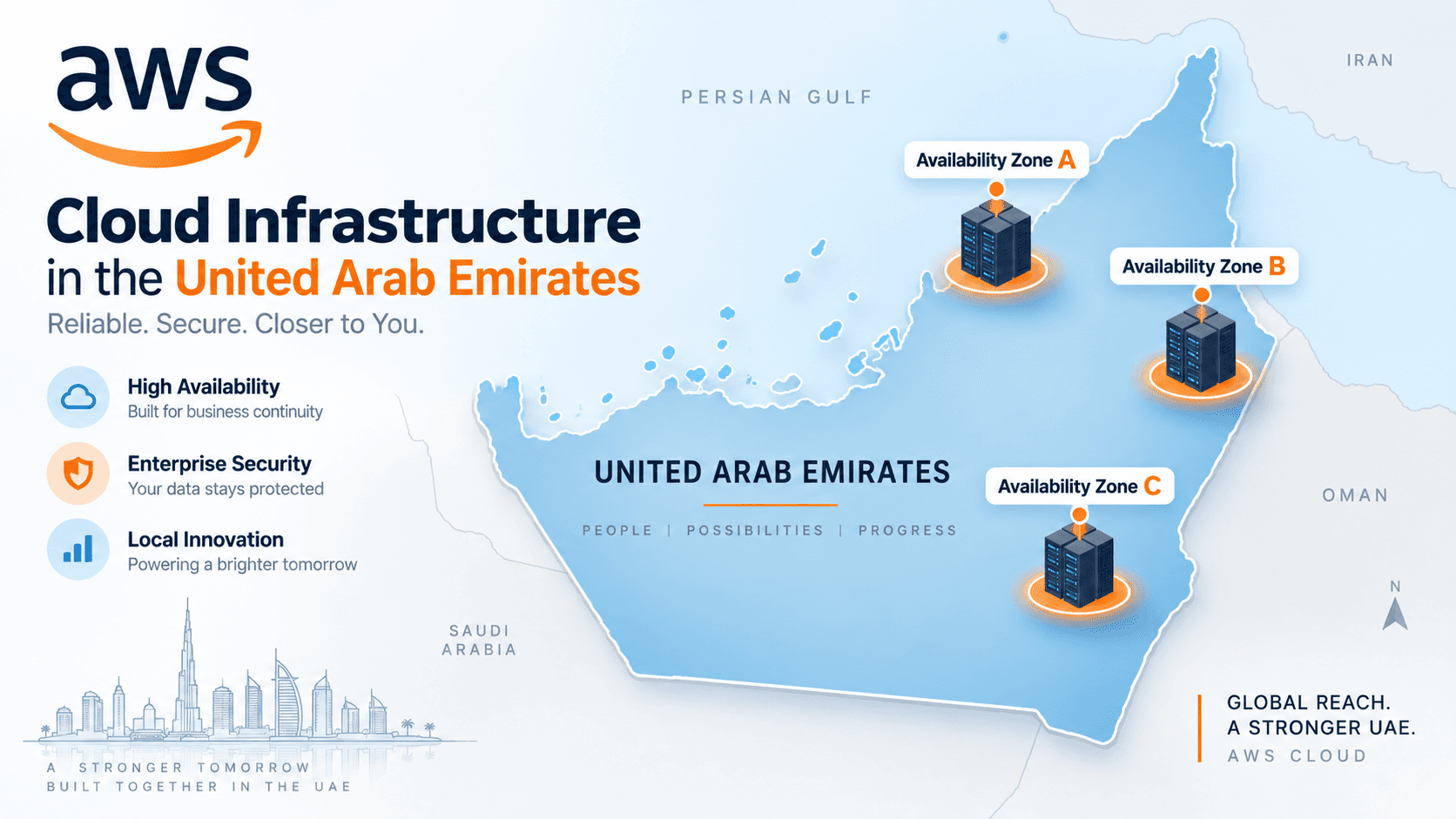 The AWS Middle East (UAE) Region (me-central-1) runs three Availability Zones inside the UAE — zone positions shown are illustrative
Why Cloud Migration in the UAE Isn't Just a Technical Lift-and-Shift
A generic cloud migration guide will tell you to inventory your servers, pick a migration strategy, and move things over in phases. All true, but incomplete for a UAE enterprise. Here's what actually changes the plan.
- Data residency isn't optional for a lot of UAE organisations. Government entities, financial institutions, and businesses in regulated sectors often have specific legal requirements to keep certain data inside the UAE. Knowing that a genuine, full-featured AWS region exists locally changes what's actually possible — this isn't a workaround, it's the standard option.
- Latency matters more than people expect. Say your business still runs some systems on-premises in Dubai or Abu Dhabi, while migrating others to the cloud gradually. The physical distance between your office and your cloud provider's servers affects how snappy your applications feel. A local UAE region minimises this in a way that routing through Bahrain, Europe, or elsewhere cannot.
- Licensing and compliance requirements often assume outdated regional options. Older contracts, internal compliance policies, or vendor agreements sometimes still reference "the nearest AWS region" as if it were Bahrain, simply because that was the accurate answer before 2022. These need reviewing and updating as part of any serious migration plan.
A Practical Migration Roadmap
Here's a realistic, phased approach for a mid-sized to large UAE enterprise.
Phase 1: Assessment (Weeks 1–4) Catalogue every system you currently run — servers, databases, and applications. For each one, identify what actually needs to move to the cloud immediately, what can wait, and what has specific data residency or compliance requirements that affect where it can go.
Phase 2: Migration Strategy Selection (Weeks 3–5, overlapping with Phase 1) Not every system moves the same way. Some can simply be "lifted and shifted" with minimal changes. Others benefit from being redesigned to take advantage of cloud-native features. Decide this system by system, not as a single blanket policy.
Phase 3: Pilot Migration (Weeks 5–10) Move a smaller, lower-risk system first. This surfaces real problems — unexpected dependencies, performance surprises, permission issues — while the stakes are still manageable.
Phase 4: Phased Full Migration (Months 3–9, depending on scope) Move remaining systems in planned waves, prioritising by business risk and complexity, not simply by which is easiest.
Phase 5: Optimisation (Ongoing) Cloud migration isn't finished at go-live. Costs, performance, and security settings need regular review — a system correctly sized for launch day often needs adjustment as real usage patterns emerge.
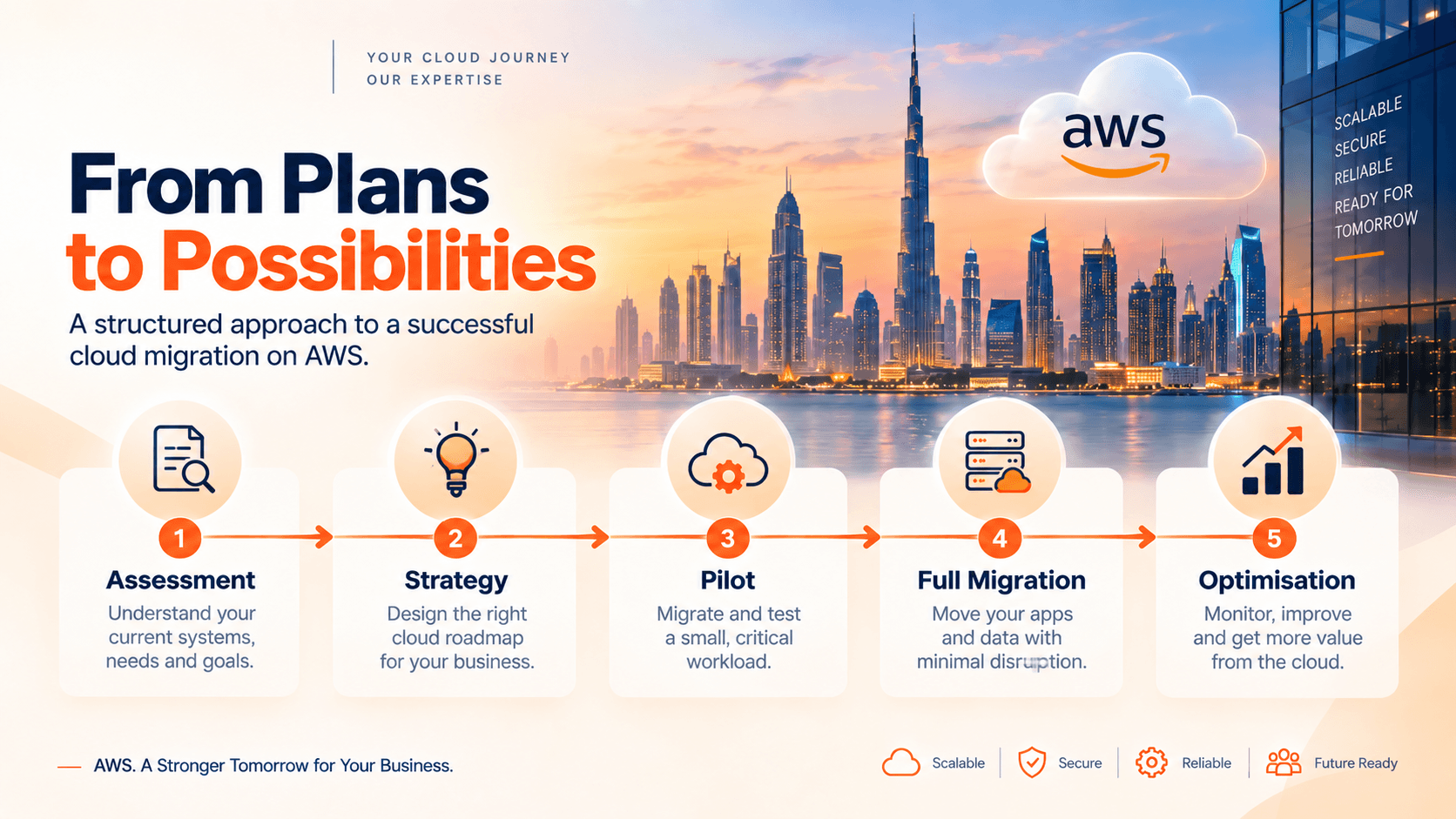 Five phases: assessment, strategy, pilot, full migration and ongoing optimisation
AWS vs Azure in the UAE — A Fair, Quick Comparison
VeeTee works with both platforms, so here's an honest take, not a sales pitch for one over the other.
Azure has strong existing UAE presence too, with UAE North and UAE Central regions. It tends to be a natural fit for organisations already deep in the Microsoft ecosystem — Office 365, Active Directory, and similar tools.
AWS tends to be a strong fit for organisations building custom applications, or using a wide range of specialised cloud services. It also suits businesses already running significant workloads on AWS elsewhere and wanting UAE-based consistency.
Neither is universally "better" — the right choice depends heavily on your existing technology stack, team expertise, and specific workload requirements. A useful gut-check question: if your team already knows one platform well, the cost of switching often outweighs marginal technical advantages of the other, unless there's a specific, compelling reason.
For a deeper look at the risk side of this decision, see our existing guide onwhy most cloud migration projects fail in the UAE. Think of it this way: this article is the practical roadmap for getting it right. That one covers what to avoid.
What to Ask Before You Choose a Migration Partner
- "Will our data be hosted in the UAE region specifically, or elsewhere by default?" Get this in writing, not just verbally confirmed.
- "What's your migration strategy for systems with specific compliance requirements?" A generic answer here is a warning sign.
- "How do you handle a pilot migration, and what happens if it surfaces a serious problem?" You want a partner with a real plan for this, not just an assumption that the pilot will go smoothly.
- "What does post-migration cost optimisation actually look like with you?" Migration isn't finished at go-live — ask how they support the months afterward.
- "Can you show a UAE-specific migration you've completed, including what went wrong and how you fixed it?" Every experienced partner has a story like this. A vendor without one hasn't done enough of these yet.
VeeTee's Cloud Migration teamworks through exactly these questions with UAE clients as a standard part of scoping any migration project.
What This Actually Costs
Cost is usually the first question, and the honest answer is that it depends heavily on your current setup. But a few general patterns hold true for UAE migrations specifically.
Data transfer costs matter more when data crosses regions. Keeping your workloads inside a single AWS region — the UAE region, in this case — generally costs less than splitting them across multiple regions unnecessarily, since moving data between regions carries its own fees.
Reserved capacity saves money for predictable workloads. If you know a system will run continuously for the next one to three years, committing to reserved pricing upfront is usually cheaper than paying standard on-demand rates the whole time.
The biggest cost surprises usually come from unused resources, not the migration itself. Systems that get provisioned generously "to be safe" during migration, then never resized down once real usage patterns are clear, are a common and avoidable source of ongoing waste.
A proper cost estimate should be part of your Phase 1 assessment, not an afterthought calculated once everything's already running.
A Realistic Example
Picture a financial services firm in Dubai running most of its core systems on ageing on-premises servers, with strict internal rules requiring customer data to stay within the UAE.
Early conversations with a previous vendor assumed this meant AWS wasn't a realistic option, since the vendor's own knowledge was outdated — built around the pre-2022 assumption that AWS meant Bahrain. This nearly pushed the firm toward a more expensive, less familiar alternative purely to satisfy a residency requirement that AWS could actually meet directly.
Once the firm confirmed AWS's actual UAE region was a real, available option, the migration plan changed significantly. Compliance requirements were met without exotic architecture. The pilot migration — a lower-risk internal reporting system — went smoothly in about six weeks, surfacing a few permission-configuration issues that were fixed before the larger, more critical systems moved in later phases.
What's Changing Next
UAE cloud regulation will likely get more specific, not less, over time. As more sensitive workloads move to the cloud, expect UAE data protection guidance to increasingly address cloud-specific scenarios directly, rather than leaving businesses to interpret general rules.
Multi-cloud and hybrid setups are becoming more common, not less. More UAE enterprises are running workloads across both AWS and Azure, rather than choosing one exclusively. They pick whichever platform suits each specific system best. This trend rewards teams with genuine expertise across platforms, not just one.
AWS's continued UAE investment through 2036 suggests the region will keep expanding capability, not just capacity. This means migration decisions made conservatively today may look unnecessarily cautious within a few years, as more advanced services become locally available.
Frequently Asked Questions
AWS operates a genuine, dedicated region physically within the UAE — the Middle East (UAE) Region, launched in August 2022 — not just a nearby facility in another country.
Both offer UAE-based regions capable of meeting most data residency requirements — the right choice depends more on your existing technology stack and team expertise than on residency alone.
It varies by scope, but a phased migration for a mid-to-large enterprise commonly takes anywhere from four to nine months from initial assessment to full completion, with ongoing optimisation continuing after that.
No — a phased approach, starting with a lower-risk pilot system, is generally safer and lets you catch problems before your most critical systems are involved.
A genuine UAE-based AWS region is available. So most data residency requirements can be met simply by ensuring workloads and storage are configured to stay within that specific region. This should be explicitly confirmed with your migration partner, not assumed.
The Bottom Line
Cloud migration in the UAE has fundamentally changed since AWS opened its own region in 2022 — data residency, latency, and compliance concerns that once required workarounds now often have a direct, local answer. Build your roadmap around today's real infrastructure, not outdated assumptions, and the migration itself becomes a manageable, phased project rather than a compliance gamble.
Get a free cloud readiness assessment mapped to UAE data residency requirements.Schedule a consultationor exploreVeeTee's Cloud Migration servicesin detail. Visitveeteetechnologies.comto see our full range of services.
Related Reading on the VeeTee Blog
External Sources Referenced in This Article
- The World Data —AWS Data Center in Dubai: Statistics & Key Facts
- Amazon —AWS Launches Region in the United Arab Emirates
Cloud infrastructure details, regional availability, and compliance requirements referenced in this article reflect publicly available information as of September 2026 — always confirm current specifics directly with AWS or a licensed migration partner before making architecture decisions.
Get in Touch
Contact Us
+91 9500945700
adm@vttech.in
No: 8/65, 1st Floor, Radhakrishnan Street, Shankaran Avenue, Velachery, Chennai, Tamil Nadu – 600042, India.
We’re here to help you !