
AWS vs Azure in 2026: Which Cloud Platform Is the Right Fit for Your Enterprise Migration?
Last Updated : 25/08/2026
Estimated : 12 min read
Author : Lokesh A
Table of Content
- Introduction
- The 2026 Market Position: Close, and Getting Closer
- Where AWS Wins
- Where Azure Wins
- The Pricing Reality: It's Closer Than Either Sales Team Admits
- The Framework That Actually Determines Success: The 6 Rs
- The AI Services Layer: Increasingly Its Own Decision
- A Decision Framework by Scenario
- Should You Run Both? The Honest Multi-Cloud Answer
- Looking Ahead: What Changes the Calculus Through 2027
- How VeeTee Approaches Cloud Migration
- Frequently Asked Questions
Introduction
"Which is better, AWS or Azure?" is the wrong question, and every serious cloud architect knows it within the first year of asking it. The right question is narrower and less satisfying to answer in a sales deck: given your existing stack, your workload types, your data residency requirements, and your five-year cost model, which platform reduces risk and cost for your specific migration? AWS and Azure together with Google Cloud control roughly 68% of global enterprise cloud spending as of Q1 2026 — and that concentration exists for real reasons, not inertia. This guide breaks down exactly when each platform wins, using real migration scenarios rather than a flattened feature checklist.
This is written for IT directors and cloud architects who are past the marketing stage of evaluation and need a decision framework grounded in workload reality, current 2026 pricing, and what actually determines migration success.
 AWS vs Azure market share and positioning chart 2026
The 2026 Market Position: Close, and Getting Closer
Market share alone should not drive your decision, but it is worth understanding what it does and doesn't tell you. AWS holds roughly 31% of global cloud infrastructure market share against Azure's 24–25%, according to Synergy Research Group's most recent reporting — but Azure has been the faster-growing of the two for several consecutive years. Gartner's 2026 Magic Quadrant for Cloud Infrastructure places both firmly in the Leaders quadrant, with AWS scoring higher on infrastructure breadth and Azure scoring higher on enterprise integration and hybrid cloud capability.
Azure's growth is not primarily an infrastructure story — it is a deals story. Microsoft already has commercial relationships with nearly every large enterprise on Earth through Office 365, Windows Server, SQL Server, Teams, and Active Directory. When those organisations evaluate cloud strategy, Azure is rarely evaluated as a standalone product — it typically arrives already embedded inside an existing Microsoft Enterprise Agreement, which changes the practical calculus of the decision well before a single technical comparison begins.
Where AWS Wins
AWS's core advantage remains sheer service depth. With over 200 managed services, AWS offers the deepest catalogue in the industry — from IoT device management to satellite ground station services to quantum computing access. For organisations building genuinely novel or highly specialised workloads, the odds that AWS already has a purpose-built managed service are simply higher. AWS's custom silicon lineup — Graviton processors for general compute, Trainium for ML training, Inferentia for ML inference — also gives it price-performance options that Azure does not currently match at the same breadth.
AWS is consistently the default recommendation for cloud-native startups and organisations building modern, containerised, microservices-based applications on Linux and open-source tooling — the service depth, developer ecosystem, and sheer volume of documented solutions for common problems make it easier to move fast without hitting platform limitations early. If your engineering culture already skews toward Kubernetes, containers, and open-source-first architecture, AWS is the path of least resistance.
Where Azure Wins
Azure's advantage is sharpest and most quantifiable for organisations with meaningful existing investment in Microsoft's stack. Azure Hybrid Benefit delivers 40–55% savings on Windows Server and SQL Server licensing costs for organisations that already own those licenses — a discount AWS has no equivalent mechanism to offer, because it does not control the underlying licensing terms Microsoft sets for its own software. Azure also charges nothing for cross-availability-zone data transfer, where AWS charges roughly $0.01/GB, a detail that adds up meaningfully for chatty, multi-AZ architectures.
Beyond pricing mechanics, Azure's native integration with Microsoft's identity and governance tooling — Active Directory, Microsoft Purview, Microsoft Defender — makes it materially easier for regulated industries with strict identity and access requirements to satisfy compliance controls than building equivalent capability on AWS from first principles. For UK and Indian enterprises already standardised on Microsoft 365 and Windows Server, this integration depth is frequently the deciding factor well before pricing enters the conversation.
The Pricing Reality: It's Closer Than Either Sales Team Admits
For Linux compute and standard object storage, AWS and Azure list prices sit within 5–10% of each other for most workloads — a gap small enough that architecture quality and resource management discipline matter far more to your final bill than which provider's logo is on the invoice. Azure tends to win specifically on Windows and SQL Server workloads through Hybrid Benefit; AWS tends to win on Kubernetes-heavy, cloud-native architectures where its broader managed-service catalogue avoids the need for custom-built equivalents.
A frequently overlooked 2026 development: all three major cloud providers now waive data-transfer egress fees for full migrations to another provider when you contact them directly and request migration credits — though the waiver is granted as a credit through an approval process, not applied automatically. A 100 TB migration that would previously have cost roughly $9,200 in egress fees alone can now often move for near-zero direct transfer cost, which meaningfully lowers the switching-cost argument that used to lock enterprises into their original provider by default.
The Framework That Actually Determines Success: The 6 Rs
The platform decision matters less than most enterprises assume relative to the migration-approach decision within that platform. Gartner's 6 Rs framework — Rehost, Replatform, Repurchase, Refactor, Retire, Retain — forces IT teams to evaluate each application individually against its actual value, risk, and complexity profile rather than applying one blanket migration approach across an entire portfolio. In practice, most enterprise migrations use a mix of all six: a typical 120-application portfolio might see 60 rehosted, 25 replatformed, 15 retired outright, 10 repurchased as SaaS, 5 retained on-premises, and 5 refactored because they are core to competitive differentiation.
This distinction is not academic. McKinsey's enterprise cloud research finds that roughly 60% of cloud migrations deliver below their projected ROI, and the dominant failure pattern is consistent: the migration defaulted to "rehost everything" because it produces the shortest project plan, not because rehosting was the right approach for most of the portfolio. Retiring genuinely redundant applications — which a proper audit typically finds accounts for 10 to 20% of an enterprise application portfolio — is consistently the most overlooked path in the framework, despite delivering some of the fastest, cleanest savings available in the entire project.
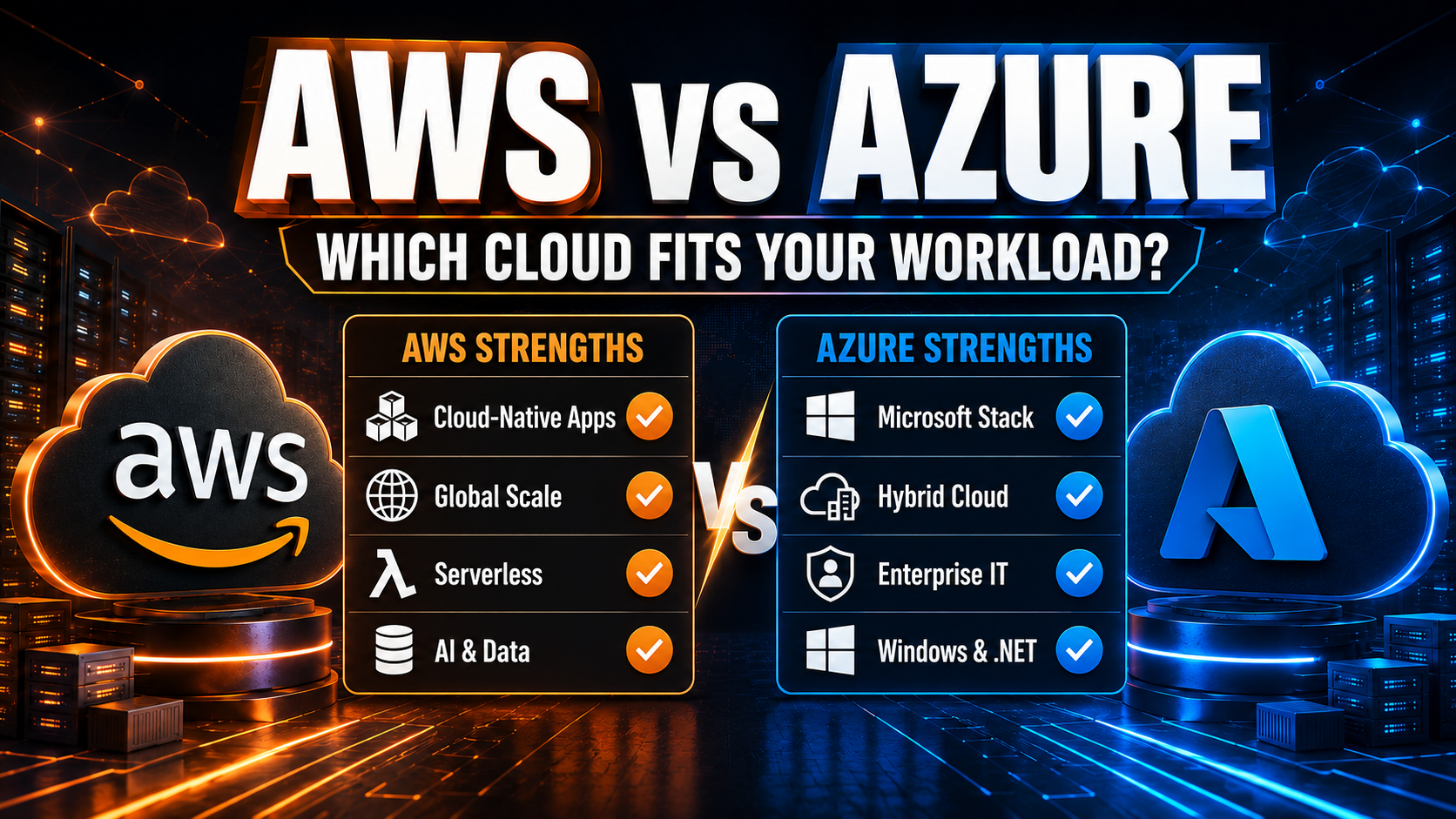 Side-by-side decision chart: AWS strengths vs Azure strengths by workload type
The AI Services Layer: Increasingly Its Own Decision
By 2026, the AI and machine learning services layer has become significant enough to function as a near-independent decision within the broader platform choice, rather than a minor feature comparison line. Azure OpenAI Service gives enterprises direct, contractually governed access to the current OpenAI model family under Microsoft's enterprise compliance and data-handling terms — a meaningful advantage for organisations whose AI strategy is explicitly built around OpenAI's models and who want that access wrapped in the same enterprise agreement and support relationship they already have with Microsoft.
AWS's answer is architectural rather than model-specific: Bedrock provides managed access to multiple foundation model providers — Anthropic, Meta, Mistral, Amazon's own Titan and Nova models, and others — through a single API, alongside SageMaker for teams building and training custom models rather than consuming a foundation model as-is. For an enterprise whose AI roadmap is not committed to a single model provider, or that wants the flexibility to switch or run multiple models side by side without re-architecting the integration layer each time, AWS's model-agnostic approach is a genuine structural advantage over Azure's tighter OpenAI-centric packaging.
The practical guidance for 2026 planning: if your organisation's AI strategy is already explicitly built around OpenAI's models and you value that arriving inside your existing Microsoft enterprise relationship, weight this toward Azure. If you want model flexibility, multi-provider access, or are building custom models rather than consuming a foundation model directly, AWS's Bedrock and SageMaker combination is architecturally the more open path. Either way, treat GPU and accelerator capacity as a contractual line item to negotiate explicitly, not an assumption — both providers have faced periods of constrained availability for the highest-demand accelerator instances during 2025 and 2026, and enterprises with business-critical training or inference workloads are increasingly securing committed capacity guarantees rather than relying on on-demand availability.
A Decision Framework by Scenario
| Your Situation | Recommended Platform | Key Reason |
|---|---|---|
| Cloud-native startup, containers/microservices | AWS | Broadest managed-service catalogue, strongest open-source ecosystem |
| Heavy Windows Server / SQL Server estate | Azure | Hybrid Benefit delivers 40–55% licensing savings |
| Deep Microsoft 365 / Active Directory investment | Azure | Native identity and governance integration |
| ML/AI workloads needing custom silicon | AWS | Graviton, Trainium, Inferentia price-performance |
| Regulated industry, strict compliance | Azure | Purview, Defender, and AD-native governance tooling |
| Multi-AZ, high internal data transfer | Azure | Zero-cost cross-AZ transfer vs AWS's $0.01/GB |
Should You Run Both? The Honest Multi-Cloud Answer
Many enterprises end up running both platforms — usually not by deliberate design but through acquisition, where two merging companies arrive with different platform choices already baked in, and maintaining both is cheaper than forcing a rebuild on one side. Running both long-term adds real operational overhead: two billing structures, two security models, two sets of certifications your team needs to maintain. This is a legitimate, common outcome — but it should be a deliberate decision made with eyes open to the overhead, not a default that accumulates by accident across a growing organisation.
A more common and often more valuable pattern for small and mid-sized teams is targeted multi-cloud use — AWS for core infrastructure, Azure specifically for Microsoft 365 identity or a single Azure-native service — rather than running parallel full estates. And regardless of provider choice, the 27% average cloud waste rate industry research attributes to poor resource management — not to running multi-cloud itself — means that rightsizing a single overprovisioned instance class typically saves more than migrating providers ever will.
Looking Ahead: What Changes the Calculus Through 2027
Two forces are reshaping enterprise cloud decisions beyond the traditional AWS-vs-Azure feature comparison. The first is AI compute capacity itself becoming a negotiated, contractual line item — enterprises with business-critical model training or inference workloads are increasingly negotiating GPU and accelerator supply guarantees, committed capacity SLAs, and price protection directly into enterprise agreements, because raw on-demand availability for AI acceleration hardware is no longer something either provider can be assumed to have on tap at short notice.
The second is data sovereignty. Worldwide sovereign cloud infrastructure-as-a-service spending is projected to reach $80 billion in 2026, driven by regulatory pressure in the EU, the Middle East, and increasingly India, requiring clear answers on data residency, auditability, and access control before a workload can be placed at all. Enterprises planning multi-year cloud strategy should treat sovereign and regional compliance requirements as a first-class input to the platform decision now, not a constraint to be retrofitted after a migration is already underway.
How VeeTee Approaches Cloud Migration
VeeTee Technologies'cloud migration practicestarts every engagement with a workload-level 6 Rs assessment, not a platform recommendation. We map your actual application portfolio, dependencies, and compliance requirements before proposing AWS, Azure, or a deliberate hybrid split — because the platform that fits your organisation depends entirely on what you are actually running today, not which vendor pitched the loudest. Our team has delivered cloud migrations across India, UAE, UK, and Canada, working within both AWS and Azure enterprise agreements.
Frequently Asked Questions
Is AWS or Azure cheaper for enterprise workloads in 2026?
Is AWS or Azure cheaper for enterprise workloads in 2026?
Neither is universally cheaper. For standard Linux compute and object storage, list prices fall within 5–10% of each other. Azure wins clearly for organisations with existing Windows Server or SQL Server licensing through Hybrid Benefit (40–55% savings) and for high-volume cross-availability-zone data transfer (free vs AWS's per-GB charge). AWS tends to offer better price-performance for cloud-native, containerised, and ML/AI workloads through its custom silicon options. The bigger cost lever for most enterprises is resource management discipline, not provider choice.
What is the 6 Rs framework and why does it matter more than the platform choice?
What is the 6 Rs framework and why does it matter more than the platform choice?
The 6 Rs — Rehost, Replatform, Repurchase, Refactor, Retire, Retain — is a framework for deciding how each individual application should move to the cloud, rather than applying one approach across an entire portfolio. It matters more than the AWS-vs-Azure decision because most migrations that fail to deliver projected ROI failed by defaulting to "rehost everything" for speed, not because they chose the wrong cloud provider. A proper 6 Rs assessment, done before any platform commitment, typically identifies that 10-20% of an application portfolio should simply be retired rather than migrated at all.
Do cloud providers really waive data transfer fees for switching between them?
Do cloud providers really waive data transfer fees for switching between them?
As of 2026, AWS, Azure, and Google Cloud have each introduced policies to waive data-transfer egress fees for enterprises conducting a full migration to another provider — but this is granted as a credit through a direct request and approval process, not applied automatically to every transfer. This has meaningfully lowered the historical switching-cost argument that made enterprises reluctant to reconsider their original cloud provider choice, though the approval process and eligibility criteria should be confirmed directly with the provider before planning a migration around it.
Should an Indian enterprise choose AWS or Azure for cloud migration?
Should an Indian enterprise choose AWS or Azure for cloud migration?
This depends on the same workload and licensing factors as anywhere else, with a few India-specific considerations: Azure often has an edge for Indian enterprises already running Microsoft-based ERP, email, and productivity stacks under an existing Enterprise Agreement, while AWS tends to be preferred for India's large base of cloud-native startups and IT services companies building on open-source, containerised architectures. Both providers have expanded India-region data centre presence, which has reduced the latency and data-residency gap that used to favour one provider regionally.
Is it a bad idea to run workloads on both AWS and Azure at the same time?
Is it a bad idea to run workloads on both AWS and Azure at the same time?
Not inherently — many enterprises run a deliberate multi-cloud footprint, commonly using one provider for core infrastructure and the other for a specific integration need, such as Azure for Microsoft 365 identity alongside an AWS-hosted application estate. The risk is not multi-cloud itself but accidental multi-cloud sprawl: running two full, unplanned estates adds duplicated billing structures, security models, and certification overhead. A deliberate, scoped multi-cloud decision is very different from platform sprawl that accumulates without a clear rationale.
Get in Touch
Contact Us
+91 9500945700
adm@vttech.in
No: 8/65, 1st Floor, Radhakrishnan Street, Shankaran Avenue, Velachery, Chennai, Tamil Nadu – 600042, India.
We’re here to help you !