Power BI Implementation in the UAE: What Dubai & Abu Dhabi Enterprises Should Ask Before Signing a Partner
Last Updated : 11/09/2026
Estimated : 14 min read
Author : Lokesh A

Table of Content
- The Question Nobody Asks Until It's Too Late
- What Power BI Implementation Actually Involves
- UAE Data Residency — Why Region Choice Isn't Just IT Trivia
- The Copilot Catch Almost Nobody Tells You About
- Licensing — What You're Actually Paying For
- Questions to Ask Before You Sign a Partner
- A Realistic Example
- What's Coming Next
- Frequently Asked Questions
- The Bottom Line
The Question Nobody Asks Until It's Too Late
A CIO in Abu Dhabi recently asked us a simple question: "Our Power BI dashboards work fine. Why is our compliance team suddenly asking where the data actually sits?"
The honest answer surprised him. Some of the newer AI features inside Power BI — the ones his team had just started using — don't run on servers in the UAE at all. They run in the United States, or in one specific location in Europe. Nobody on the implementation side had mentioned this before turning the feature on.
This isn't a rare mistake. It's an easy one to make, because most Power BI content online is written for a general, global audience. It doesn't cover what's actually different about running Power BI in the UAE.
This article does. If you're a CIO, IT director, or analytics lead in Dubai or Abu Dhabi, here's exactly what to check before you sign an implementation partner.
What Power BI Implementation Actually Involves
Let's start simple. Power BI is a tool from Microsoft that turns raw business data into charts, dashboards, and reports. Think of it as a visual summary. It helps a manager see what's happening in the business without opening ten spreadsheets.
"Implementation" means the actual work of connecting Power BI to your real data — your sales system, your finance system, your operations data. It means building the specific reports your teams need, safely and correctly.
Sounds straightforward. In the UAE, three things make it more complicated than a typical tutorial suggests. Where can your data legally live? Which AI features actually work here? And what are you really paying for? Let's take each one in order.
UAE Data Residency — Why Region Choice Isn't Just IT Trivia
Microsoft runs its cloud services from data centres in specific physical locations, called "regions." For the Gulf, the main ones are:
- Azure UAE North (Dubai) — supports the full Microsoft Fabric platform, including Power BI, data engineering, and data science tools. This is currently the only Middle East region with everything available.
- Azure UAE Central (Abu Dhabi) — supports Power BI, but not the full Fabric platform.
- Azure Qatar Central (Doha) — also Power BI only, not full Fabric.
- Saudi Arabia East — confirmed for late 2026, expected to offer fuller capabilities once live (source:Beyond The Analytics, Power BI Data Residency: UAE PDPL, Saudi NDMO & Azure Regions).
Why does this matter beyond IT preference? Because UAE data protection law — the UAE PDPL — cares about where your data physically sits, not just how it's secured. So do free zone rules like DIFC's data protection regulation. If your organisation is legally required to keep certain data inside the UAE, the region your Power BI environment runs in isn't a technical detail. It's a compliance decision.
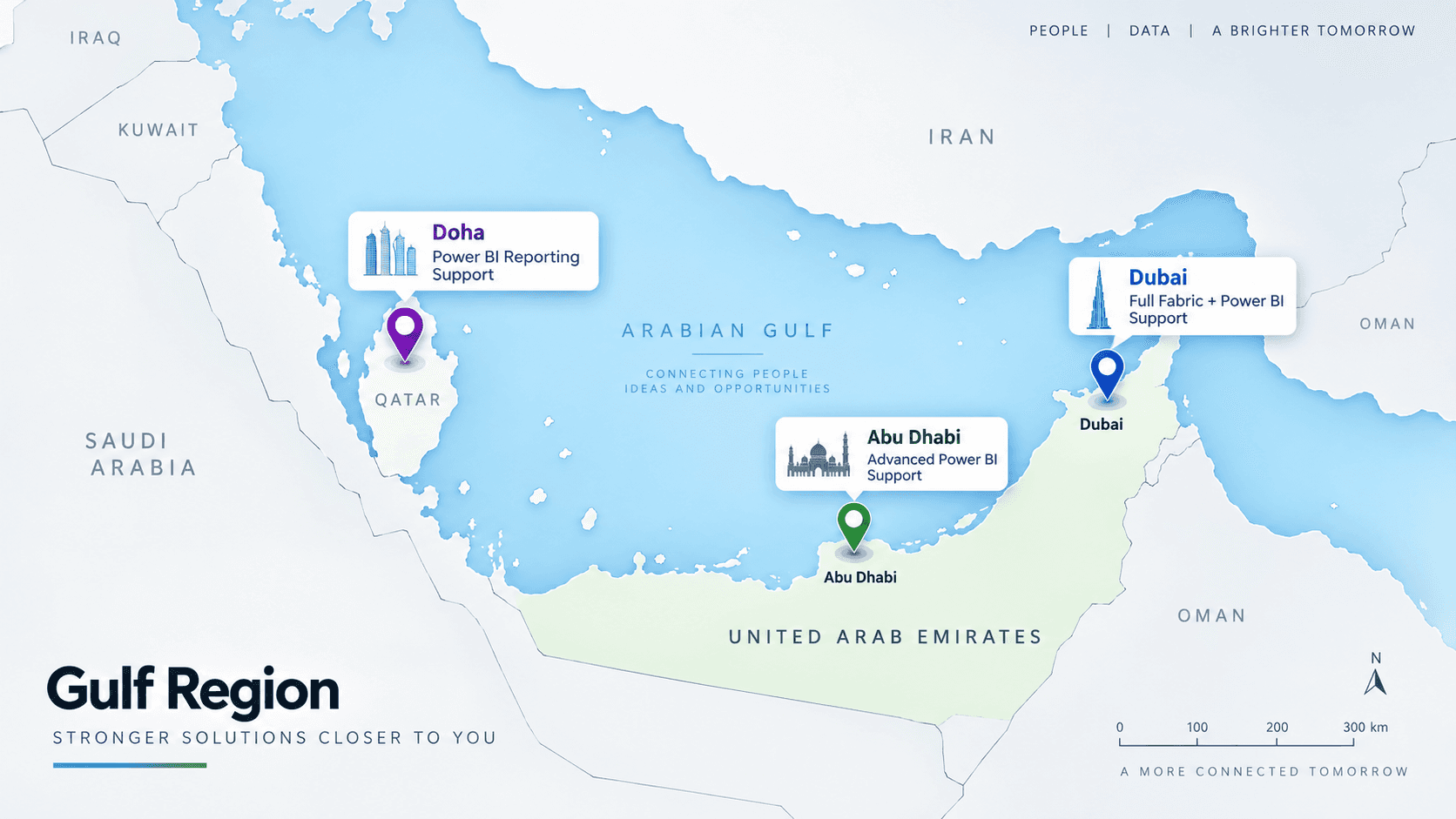 UAE North (Dubai) runs full Microsoft Fabric; UAE Central (Abu Dhabi) and Qatar Central (Doha) run Power BI only
The Copilot Catch Almost Nobody Tells You About
Here's the detail that surprised the CIO in our opening story — and it's worth explaining clearly, because it affects a growing number of UAE Power BI users.
Copilot is Microsoft's AI assistant built into Power BI. It can write queries, summarise data, and generate reports just from a plain-language request. It's genuinely useful. But it needs help to work. It depends on a separate Microsoft service called Azure OpenAI to actually think and respond. And Azure OpenAI is currently only available in United States data centres, plus one location in Europe (France Central) (source:Beyond The Analytics, Power BI Copilot Enterprise Readiness).
Here's what that means in plain terms: no Gulf region currently hosts Azure OpenAI. So even in Azure UAE North — the region that supports every other part of Microsoft Fabric — turning on Copilot changes things. Your prompts, some data-model details, and query results get sent to a US or European data centre to be processed. Then the answer comes back to you.
Microsoft states this data isn't used to train its AI models. But it does cross an international border to get processed. That's exactly the kind of thing UAE PDPL and DIFC data rules ask organisations to review carefully, before switching a feature like this on (source:Beyond The Analytics).
To make this more specific: Qatar Central and UAE Central are explicitly listed as regions where the full Copilot experience isn't available at all. UAE North is not on that exclusion list — but it still requires this cross-region data handling to work.
What you should actually do with this information: it doesn't mean avoid Copilot. It means treat turning it on as a decision your legal or compliance team should be part of — not something an implementation partner quietly enables by default because it "just works."
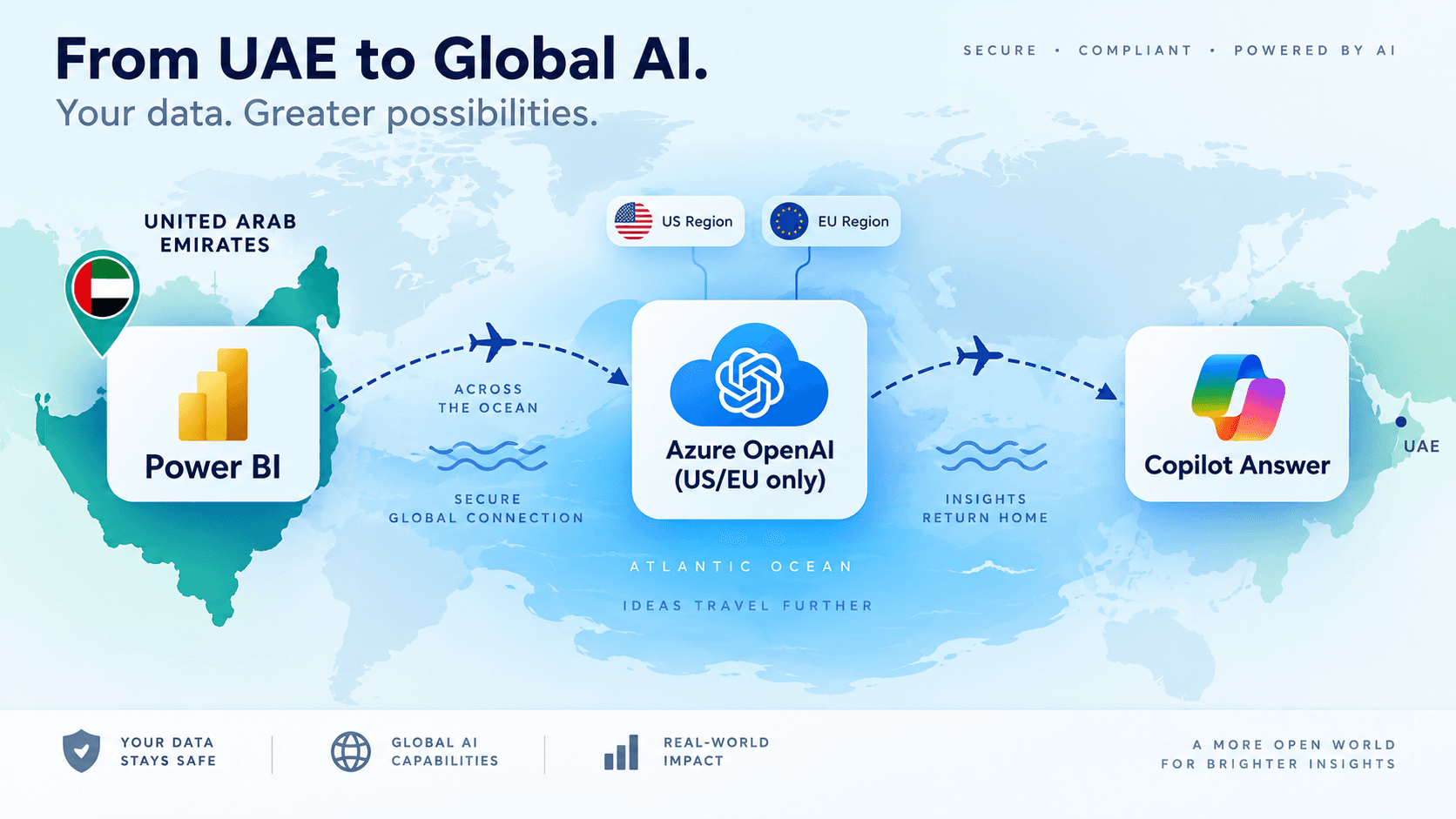 Copilot sends prompts, model details and query results to Azure OpenAI in the US or EU, then returns the answer to your report
Licensing — What You're Actually Paying For
Power BI licensing confuses a lot of buyers, so here's the real breakdown as of 2026:
- Power BI Pro costs about $14 per user, per month, and covers standard reports and dashboards.
- Power BI Premium Per User (PPU) costs about $24 per user, per month, and adds larger datasets and some advanced features.
- To use Copilot at all, you need a paid Microsoft Fabric capacity. This starts at the F2 tier, around $260 a month. Or you can use a Premium P1 capacity instead, which costs significantly more — around $4,995 a month (source:Tygart Media, Copilot in Power BI: Setup & Licensing Guide). A Pro or PPU license alone does not switch Copilot on, no matter how many users have one.
- If your organisation needs to pin specific data to a specific region, that feature is called Multi-Geo. For example, you might need to keep UAE data in UAE North specifically. Multi-Geo is only available on Fabric capacity, not on Pro or PPU alone (source:Beyond The Analytics, Power BI Pro vs Premium Per User vs Fabric).
The practical takeaway: data residency matters to most UAE enterprises. If it matters to yours, a simple Pro or PPU rollout won't fully solve that on its own. You need to plan for Fabric capacity from the start, not add it later as an afterthought.
Questions to Ask Before You Sign a Partner
Use these directly in your next vendor conversation.
- "Which Azure region will our Power BI environment actually run in, and why?" A vague answer here is a warning sign.
- "If we enable Copilot, exactly where does that data get processed?" A partner who knows the UAE market well should answer this without hesitating.
- "Do we need Multi-Geo, and does our licensing actually include it?" This determines whether region-specific data placement is even possible for us.
- "Has your team involved our legal or compliance team in any AI feature rollout plan?" If the answer is no, that's a process gap worth fixing before go-live, not after.
- "What does our data model look like in two years, not just today?" Poor early data-model decisions are expensive to unwind later — ask for their reasoning, not just their recommendation.
VeeTee'sPower BI Implementation teamworks with these exact regional and compliance questions daily across UAE clients — we're happy to walk through all five with you directly.
A Realistic Example
Picture a logistics company in Dubai that rolled out Power BI to track shipments, costs, and delivery performance across the Gulf.
Early on, an enthusiastic project lead enabled Copilot for the analytics team, mainly because it made building reports faster. Nobody flagged it to compliance. Months later, during a routine data governance review, the question came up: where exactly does this AI processing happen?
The company wasn't in breach of anything — Microsoft's data handling terms were being followed correctly. But nobody had made an informed decision. It had simply been switched on because it was convenient. After the review, the company kept using Copilot. But now there was a clear, written decision on file. It named which teams could use it. It explained why the cross-region processing was acceptable for their specific data. And it named who owned that decision going forward.
That's the real goal here — not necessarily saying no to AI features, but making sure someone actually said yes on purpose.
What's Coming Next
Saudi Arabia's new region may shift the regional picture again. It's confirmed for late 2026. It's expected to bring fuller Fabric capabilities to a second Gulf location. This is worth tracking if your organisation operates across both the UAE and Saudi Arabia.
Microsoft is expanding how AI agents can work directly with Fabric and Power BI data. Recent tools now let external AI assistants read, and even help build, Power BI reports and data models. As these capabilities spread, the same regional and data-residency questions in this article will apply to each new feature. Asking "where does this actually run" needs to become a standing habit, not a one-time question.
Expect UAE PDPL and DIFC guidance to get more specific about AI processing over time. Regulators are catching up to how quickly features like Copilot are being adopted across Gulf enterprises. Organisations that already have clear internal review processes will adapt faster than those making these decisions feature by feature, after the fact.
Frequently Asked Questions
For most standard reporting and dashboards, yes, if you use Fabric capacity with Multi-Geo pinned to UAE North. For AI features like Copilot specifically, some data processing currently happens outside the UAE, regardless of which Gulf region you're based in.
For basic reporting without strict data residency requirements, often yes. Once residency requirements, larger datasets, or Copilot come into the picture, you'll likely need Fabric capacity instead.
Not automatically. But it does involve data processing outside the UAE. UAE PDPL and DIFC rules expect organisations to actively review and approve that, rather than enable it by default.
UAE North (Dubai) supports the complete Microsoft Fabric platform. UAE Central (Abu Dhabi) supports Power BI but not the full Fabric feature set — worth confirming which one your implementation actually uses.
Costs vary by scope. Licensing alone can range from roughly $14 a user a month for basic Pro access, up to several thousand dollars a month for the Fabric capacity needed for Copilot and Multi-Geo. Implementation and report-building work is a separate cost on top of licensing.
Since 2026, Power BI Premium capacity has effectively become part of the Fabric platform, under new naming called F-SKUs. In practice, most new UAE deployments should plan around Fabric capacity tiers rather than legacy Premium plans.
The Bottom Line
Power BI implementation in the UAE isn't fundamentally different from anywhere else — until you get to data residency and AI features, where it very much is. Ask about region, ask about Copilot's actual data path, and make sure compliance is part of the conversation before go-live, not after a routine audit finds it first.
Get a free Power BI implementation roadmap from VeeTee's UAE-focused BI team.Schedule a consultationor exploreVeeTee's Power BI Implementation servicesin detail.
Related Reading on the VeeTee Blog
External Sources Referenced in This Article
- Beyond The Analytics —Power BI Data Residency: UAE PDPL, Saudi NDMO & Azure Regions
- Beyond The Analytics —Power BI Copilot Enterprise Readiness: How to Prepare Your Semantic Models
- Beyond The Analytics —Power BI Pro vs Premium Per User vs Fabric: Licensing Decision Tree
- Tygart Media —Copilot in Power BI: Setup & Licensing Guide (2026)
Microsoft's regional availability, pricing, and data-handling policies for Power BI and Copilot change regularly — the details in this article reflect publicly available information as of September 2026. Always confirm current terms directly with Microsoft or a licensed partner before making compliance decisions.
Get in Touch
Contact Us
+91 9500945700
adm@vttech.in
No: 8/65, 1st Floor, Radhakrishnan Street, Shankaran Avenue, Velachery, Chennai, Tamil Nadu – 600042, India.
We’re here to help you !