
React Native vs Flutter vs Kotlin Multiplatform: Which Cross-Platform Framework for Enterprises in 2026?
Last Updated : 20/08/2026
Estimated : 14 min read
Author : Lokesh A
Table of Content
- Introduction
- The Three Architectural Approaches, in Plain Terms
- React Native in 2026: Where It Stands
- Flutter in 2026: Where It Stands
- Kotlin Multiplatform in 2026: The Fastest-Growing Option
- What Enterprise Case Patterns Actually Show
- Looking Ahead: Where Cross-Platform Development Goes Next
- How VeeTee Helps Enterprises Choose and Build
- Book a free cross-platform framework scoping call
- Frequently Asked Questions (FAQ)
Introduction
Every cross-platform mobile comparison published in the last five years eventually declares a winner. That approach has quietly become wrong. In 2026, React Native, Flutter, and Kotlin Multiplatform have each matured into genuinely production-ready choices for enterprise mobile development — and the frameworks now diverge less on raw capability than on which specific constraints your organisation is optimising for: team skill composition, release cadence, native API depth, and long-term maintenance cost. Getting this decision wrong does not usually show up in month one. It shows up eighteen months in, as a mobile team fighting the framework instead of the product.
This guide breaks down what each framework actually delivers in 2026, where enterprises are using each one in production today, and a decision framework built around the constraints that determine the right answer for your specific organisation — not a generic universal ranking.
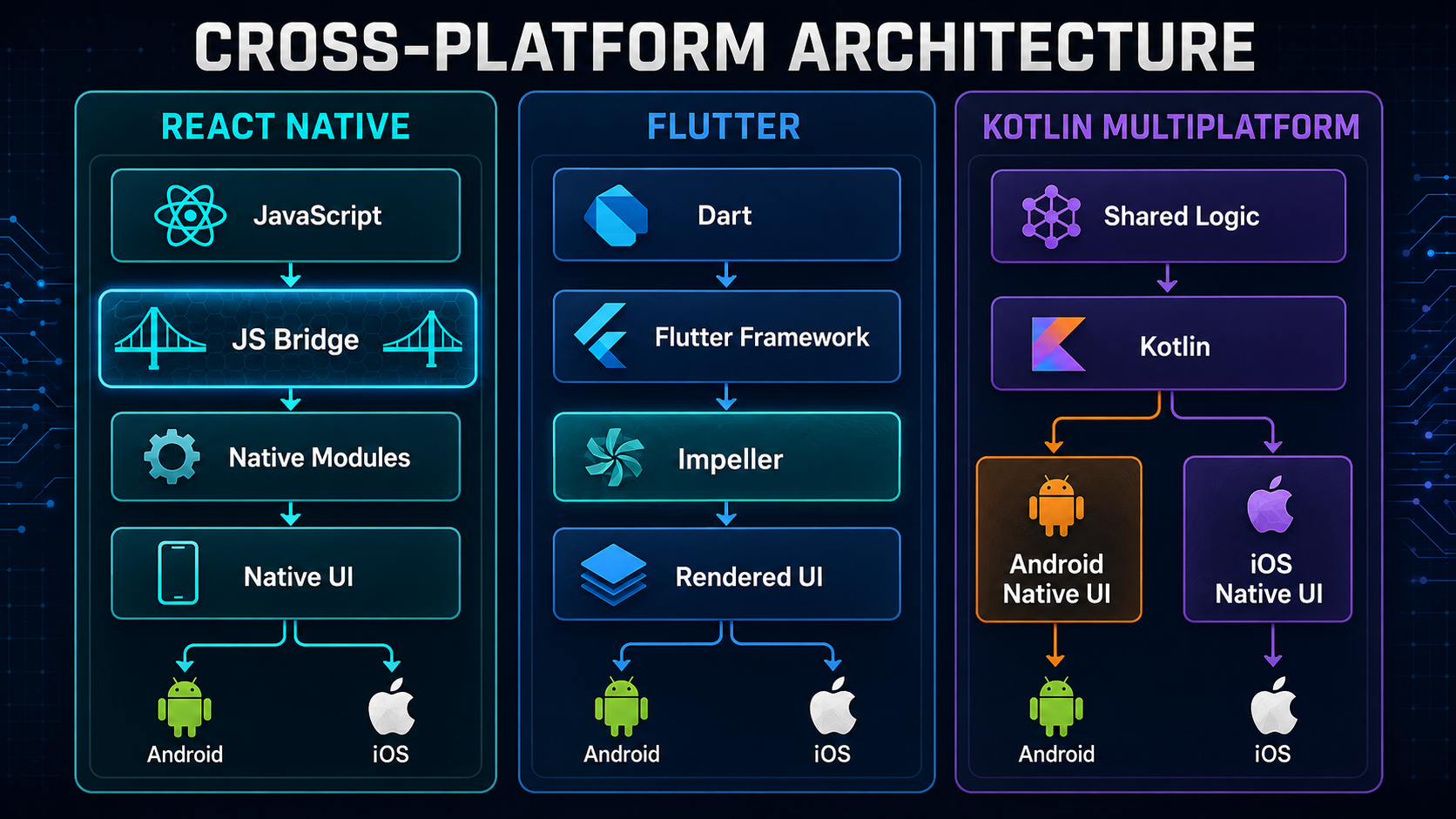 Three production-ready cross-platform approaches for enterprise mobile in 2026
The Three Architectural Approaches, in Plain Terms
Understanding each framework's underlying architecture matters more than benchmark numbers, because architecture is what determines debugging experience, native API access, hiring difficulty, and long-term maintenance cost — the things that actually drive total cost of ownership. A detailed 2026 KMP comparison frames the core distinction well: React Native and Flutter each render their own UI layer across platforms from a single codebase, while Kotlin Multiplatform shares only the business logic — networking, data processing, state management — and renders UI natively per platform.
React Native uses JavaScript (or TypeScript) with a bridge — increasingly the New Architecture's JSI (JavaScript Interface) — connecting your code to native platform components. Flutter compiles Dart to native ARM code and renders every pixel itself through its own rendering engine, meaning your UI looks identical on iOS and Android by design, not by coincidence. Kotlin Multiplatform compiles Kotlin business logic to native code per platform with no bridge and no virtual machine, while iOS and Android each keep their fully native UI layer — SwiftUI or UIKit on iOS, Jetpack Compose on Android.
| React Native | Flutter | Kotlin Multiplatform | |
|---|---|---|---|
| Language | JavaScript / TypeScript | Dart | Kotlin (+ Swift and Kotlin for UI) |
| What is shared | UI and logic | UI and logic | Business logic only |
| UI layer | Native components via the JSI bridge | Self-rendered by the Impeller engine | Fully native — SwiftUI/UIKit and Jetpack Compose |
| Strongest fit | Teams with deep React/JS expertise; logic shared with a React web app | Pixel-consistent branding across up to six platforms; fast unified iteration | Fintech, healthcare, logistics — native UX, security and long-term maintainability |
| Main trade-off | Mobile-specific innovation moving more slowly than rivals | Your team owns the 16 ms frame budget and rendering discipline | Two UI codebases to build and maintain |
React Native in 2026: Where It Stands
React Native's biggest 2025–2026 shift is architectural, not cosmetic. The New Architecture combined with Hermes V1 has significantly improved startup and runtime performance, meaningfully narrowing the historical gap with Flutter and native development where JavaScript-based logic previously introduced real overhead. React Native remains the strongest choice when your team has deep JavaScript and web expertise already, when you want to reuse business logic between a React web app and mobile, and when the extensive JavaScript ecosystem of libraries accelerates specific feature development.
The honest caveat, noted across multiple 2026 technical comparisons, is strategic direction: React Native is Meta-backed and stable, but several analysts flag it as moving more slowly toward mobile-specific innovation relative to Flutter and KMP, with Meta's investment increasingly weighted toward web-first priorities. For teams already fluent in React, it remains a genuinely practical choice — the risk is treating it as the default rather than the deliberate one.
Flutter in 2026: Where It Stands
Flutter has evolved from a mobile-first UI toolkit into a genuine multi-platform framework. With the Impeller rendering engine now stable across iOS and Android, Flutter delivers consistent 120fps performance on modern devices and supports six target platforms — iOS, Android, web, Windows, macOS, and Linux — from a single Dart codebase. Google's own investment has only deepened, with Flutter powering the Google Classroom mobile app, the Google Pay interface, and numerous internal Google tools.
Dart, Flutter's language, is statically typed with syntax familiar to developers coming from Java, Kotlin, C#, or TypeScript — most experienced developers become productive within one to two weeks, though the smaller existing Dart talent pool means fewer experienced hires available off the shelf compared to JavaScript or Kotlin. Flutter's tooling is genuinely excellent out of the box: a widget inspector, performance profiler, memory debugger, and network monitor, with first-class VS Code and Android Studio integration. The trade-off worth naming plainly: Flutter's performance guidance requires developers to actively avoid expensive build, layout, and paint operations and keep frame work within a 16-millisecond budget for smooth rendering — Flutter gives you UI consistency, but your team owns the rendering discipline that keeps it fast.
Kotlin Multiplatform in 2026: The Fastest-Growing Option
The single most striking data point in the 2026 cross-platform landscape is Kotlin Multiplatform's adoption trajectory: KMP adoption jumped from 7% in 2024 to 23% in 2025 — a threefold increase in a single year that signals genuine market validation rather than speculative interest. This is not confined to experimentation: Netflix, Google Workspace, and Cash App are running KMP in production serving millions of daily users. Airbnb's return to shared cross-platform code through KMP, after previously abandoning React Native, is frequently cited as evidence that framework choice must match organisational engineering culture, not just technical capability. Duolingo shares roughly 80% of its business logic across platforms through KMP with simultaneous release cadence across iOS and Android.
KMP's core proposition is sharing business logic while keeping fully native UI per platform — which means your iOS app genuinely looks and feels like an iOS app, and your Android app genuinely looks and feels like an Android app, while networking, data models, validation, and state management logic are written once. This makes KMP particularly strong for enterprise applications, fintech, healthcare, and logistics — categories where native platform conventions, strict security guarantees, and long-term maintainability outweigh the value of pixel-identical UI across platforms. The trade-off is that you are still building and maintaining two UI layers, which requires either two specialised UI teams or engineers comfortable working in both SwiftUI/UIKit and Jetpack Compose.
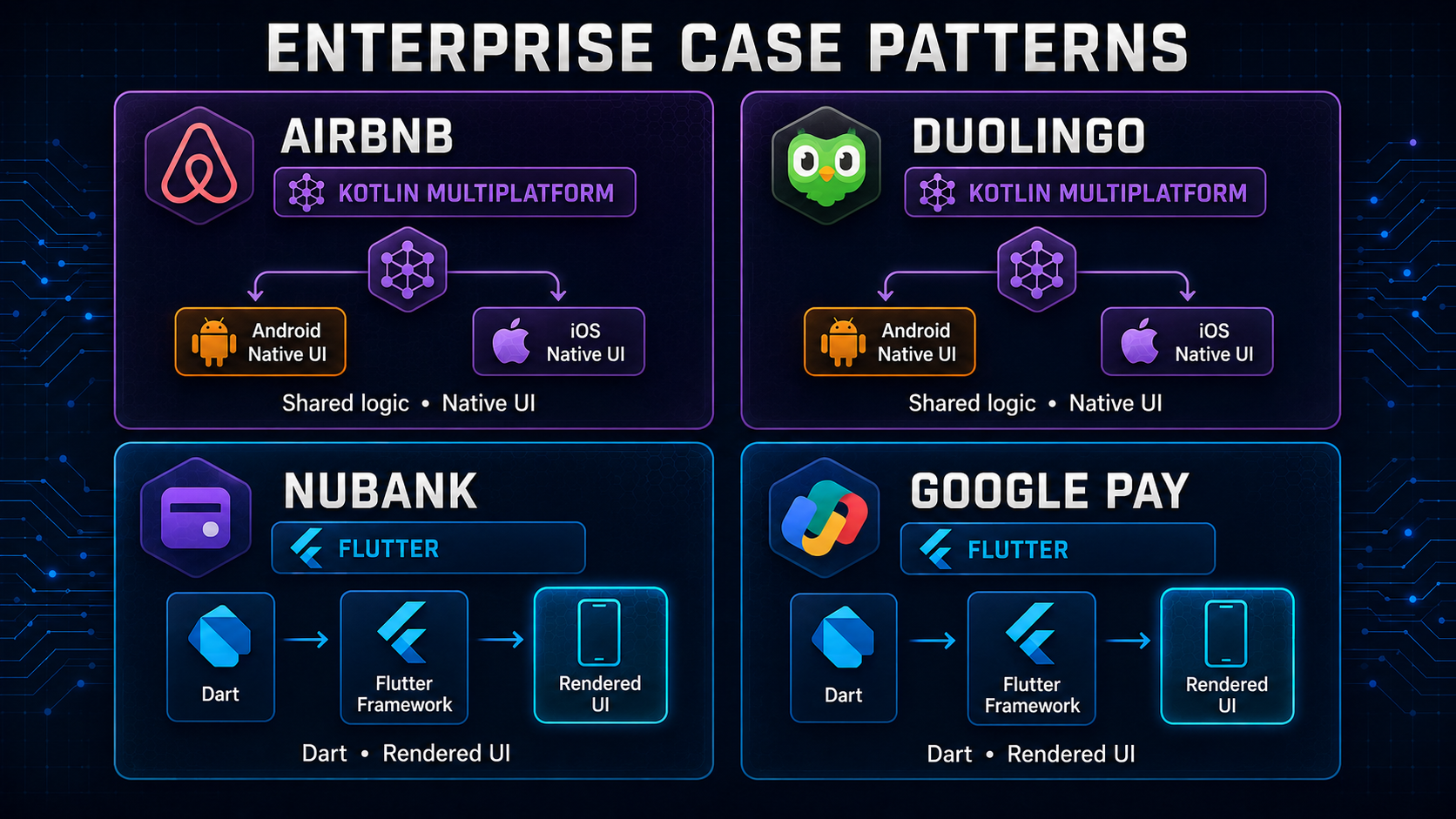 Shared-logic vs shared-UI: what each framework actually gives you across iOS and Android
What Enterprise Case Patterns Actually Show
Real production deployments are more instructive than framework marketing. Java Code Geeks' 2026 analysis of enterprise migrations documents that Nubank achieved a thirty percent efficiency gain adopting Flutter's single-codebase approach for its fintech product — validating Flutter specifically where rapid iteration on a consistent UI matters more than platform-native conventions. The pattern across successful framework migrations, and the inverse pattern across failed ones, is consistent: success comes from measuring results objectively against a specific use case, while failures typically stem from attempting a big-bang framework rewrite without proper evaluation against the organisation's actual constraints.
The most significant 2026 strategic shift is that the binary “pick one framework” question is increasingly the wrong question. Companies are increasingly running multiple frameworks simultaneously and deliberately — Kotlin Multiplatform for performance-critical, security-sensitive business logic; React Native for rapid prototyping and MVP validation; Flutter for polished, consumer-facing applications — deploying each where its specific strengths matter most rather than forcing one framework across every mobile initiative in the organisation.
Looking Ahead: Where Cross-Platform Development Goes Next
Kotlin Multiplatform's growth trajectory is unlikely to plateau soon. With JetBrains and Google jointly continuing investment in KMP tooling, expect the shared-logic model to extend further — into desktop, web, and backend targets alongside mobile, which would let enterprises share a single business-logic layer across their entire application surface, not just iOS and Android. Flutter's WebAssembly compilation path is maturing in parallel, extending Flutter's single-codebase promise more credibly into full production web deployment rather than a secondary target.
AI-assisted development tooling is also reshaping the framework calculus. Ascoding assistantsbecome genuinely proficient at generating and refactoring Dart, Kotlin, and TypeScript, the traditional “talent pool size” argument in favour of React Native's larger JavaScript hiring pool weakens somewhat — a well-directed senior engineer with AI tooling can increasingly work productively across frameworks that would previously have required deep, years-long specialisation. This does not eliminate the architecture decision; it shifts the weighting further toward long-term maintainability and platform-native quality, which is precisely the direction Kotlin Multiplatform's growth curve already reflects.
How VeeTee Helps Enterprises Choose and Build
VeeTee'smobile development practicehas delivered Android, iOS, and cross-platform applications across React Native, Flutter, and Kotlin Multiplatform for enterprise clients over 17 years. We do not default to a single framework — our scoping process starts with your team's existing skills, release cadence requirements, native API needs, and long-term maintenance appetite, then recommends the framework that fits, including a mixed-framework strategy where that genuinely serves the product better than a single default. If you are still shaping the product itself rather than the stack, ourguide to building a focused mobile app strategyis the better place to start.
Book a free cross-platform framework scoping call
Whether you are choosing a framework for a new enterprise mobile build or reassessing one that is no longer serving the product, a short review with an experienced cross-platform team will surface the constraints that should actually decide it.Talk to our mobile engineering teamto book yours — no commitment required.
Frequently Asked Questions (FAQ)
Is Kotlin Multiplatform better than Flutter for enterprise apps in 2026?
Is Kotlin Multiplatform better than Flutter for enterprise apps in 2026?
It depends on what “better” means for your specific case. KMP is the stronger choice when native platform UX, strict security guarantees, and long-term maintainability with fully native UI per platform matter most — common in fintech, healthcare, and regulated enterprise software. Flutter is the stronger choice when pixel-consistent branding across platforms and fast, unified iteration matter more than native platform conventions. Neither is universally superior; the right choice depends on your product's actual constraints.
Has React Native fallen behind Flutter and Kotlin Multiplatform in 2026?
Has React Native fallen behind Flutter and Kotlin Multiplatform in 2026?
No — React Native's New Architecture and Hermes V1 runtime have meaningfully closed the historical performance gap, and it remains a strong, practical choice for teams with deep JavaScript and React expertise who value fast time-to-market and the large JS ecosystem. What has changed is that it is no longer the default “safe choice” it once was; Flutter and KMP have each built genuine, differentiated strengths that make the decision a real trade-off rather than a formality.
Can an enterprise use more than one cross-platform framework at once?
Can an enterprise use more than one cross-platform framework at once?
Yes, and it is an increasingly common 2026 strategy among larger organisations — using Kotlin Multiplatform for performance-critical, security-sensitive business logic, React Native for rapid prototyping and MVP validation, and Flutter for polished consumer-facing applications, deploying each framework specifically where its strengths matter most rather than forcing a single framework across every initiative. This requires more platform expertise to manage but avoids compromising each product on a framework that is not actually the best fit for it.
Does Kotlin Multiplatform mean building two separate UIs?
Does Kotlin Multiplatform mean building two separate UIs?
Yes — KMP shares business logic (networking, data processing, state management) across platforms but requires native UI per platform: SwiftUI or UIKit for iOS, Jetpack Compose for Android. This is a deliberate trade-off, not a limitation: you get fully native look, feel, and platform-convention compliance on each OS, at the cost of maintaining two UI codebases instead of one. For products where native UX quality is a priority, this trade-off is usually worth it; for products prioritising a single, brand-consistent UI shipped fast, Flutter's single UI layer is often the better fit.
How do I decide between these three frameworks for a new enterprise mobile project?
How do I decide between these three frameworks for a new enterprise mobile project?
Start with three questions, in this order: what does your existing engineering team already know (JavaScript points toward React Native, Kotlin/Android points toward KMP, neither points toward evaluating Flutter fresh); how important is pixel-identical UI across platforms versus native platform conventions (identical UI favours Flutter, native conventions favour KMP); and what is your realistic release cadence and long-term maintenance horizon. A structured scoping conversation with an experienced cross-platform team, rather than a generic online comparison, is usually the fastest way to a confident answer for your specific product.
Get in Touch
Contact Us
+91 9500945700
adm@vttech.in
No: 8/65, 1st Floor, Radhakrishnan Street, Shankaran Avenue, Velachery, Chennai, Tamil Nadu – 600042, India.
We’re here to help you !