
The Real Cost of Neglecting App Maintenance: A Guide for Singapore Businesses
Last Updated : 16/09/2026
Estimated : 13 min read
Author : Lokesh A

Table of Content
- The App That Used to Work Fine
- What "App Maintenance" Actually Means
- Why This Matters More in 2026 Than It Used To
- What Neglected Maintenance Actually Costs
- Maintenance and Singapore's Data Protection Law
- Web App vs Mobile App Maintenance — Different Risks, Same Discipline
- How Grants Fit Into the Picture — And Where They Don't
- Building a Maintenance Plan That Actually Works
- A Realistic Example
- What's Changing Next
- Frequently Asked Questions
- The Bottom Line
The App That Used to Work Fine
Here's something that catches a lot of Singapore business owners off guard. An app doesn't need anything to go wrong for it to get worse. It just needs to be left alone.
Phones get new operating systems. Payment gateways update their rules. Security standards move forward. If nobody is actively keeping your app in step with all of that, it doesn't stay the same — it slowly falls behind. Buttons that worked fine last year start behaving oddly on this year's phones. A security patch that should have gone out six months ago still hasn't happened.
None of this shows up as one big, obvious failure. It shows up as a slow accumulation of small annoyances, until one day a customer can't complete a purchase, and nobody can say exactly when that became true.
This guide explains what neglecting app maintenance actually costs a Singapore business, and how to build a maintenance plan that catches problems before your customers do.
What "App Maintenance" Actually Means
Let's define this simply. App maintenance is the ongoing work of keeping an app running well after it's launched — not building new features, just keeping the existing ones working correctly, securely, and quickly.
That includes:
- Fixing bugs that appear after real users start using the app in ways developers didn't originally test.
- Applying security patches, so known vulnerabilities get closed before someone exploits them.
- Updating for new phone operating systems, since Apple and Google update iOS and Android regularly, and apps that aren't tested against these updates can break without warning.
- Keeping third-party connections working — payment gateways, maps, messaging services, and similar tools all change their own systems over time, and your app needs to keep pace.
Think of it like a car. You don't need a new car every year. But skip the servicing entirely, and the same car quietly becomes less safe and less reliable — even though nothing dramatic happened on any single day.
Why This Matters More in 2026 Than It Used To
Singapore businesses are under more digital pressure than most. The government has actively pushed the country toward heavy digital adoption for years, and that trend keeps deepening.
The Infocomm Media Development Authority, or IMDA, runs Singapore's national SME digitalisation programme. It has a real budget behind it — SGD 1.04 billion allocated to IMDA specifically for this kind of work (source:OECD, Singapore SME Digitalisation Support Programme). Around 88,000 SMEs — roughly 30% of Singapore's entire SME population — have already been supported through this programme.
What that means practically: more of your customers, suppliers, and competitors are running on digital tools than ever before. An app that quietly degrades doesn't just annoy the people using it — it puts you at a real disadvantage against competitors who are actively maintaining theirs.
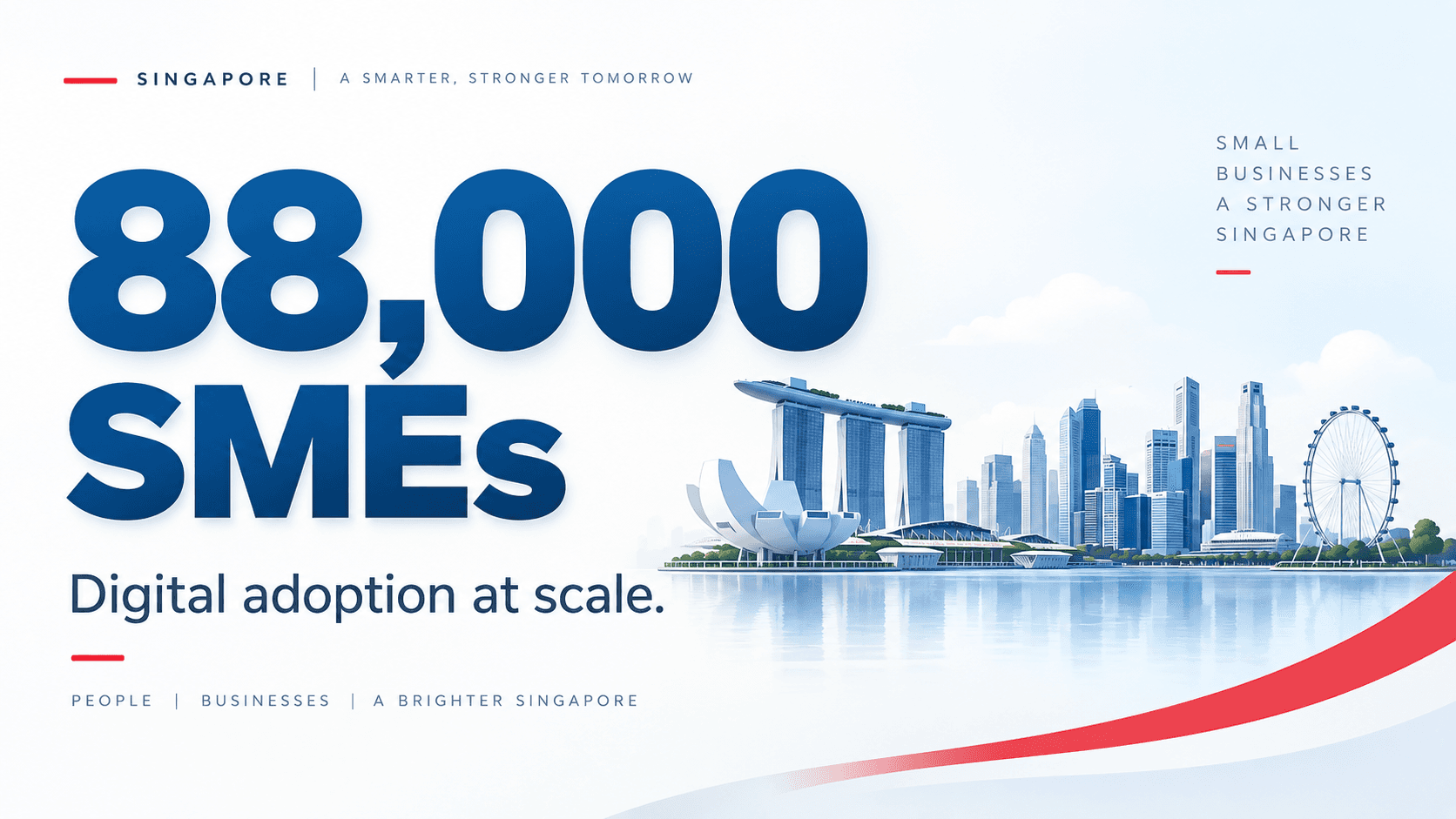 Around 88,000 Singapore SMEs — roughly 30% of the SME population — have been supported through IMDA's digitalisation programme
What Neglected Maintenance Actually Costs
- Slower performance drives customers away quietly. Unlike a crash, slow performance rarely gets reported. Customers just quietly use the app less, or switch to a competitor, without ever filing a complaint that tells you why.
- Security gaps become bigger targets over time. An unpatched vulnerability doesn't get safer with age — it gets more dangerous, because more people learn how to exploit it as time passes.
- Compatibility breaks arrive without warning. When Apple or Google pushes a major OS update, apps that haven't been tested against it can suddenly stop working properly for a large share of users, seemingly overnight.
- Small bugs compound into expensive rewrites. A codebase that's patched carelessly, without proper testing, tends to accumulate small inconsistencies. Eventually, what would have been a simple fix becomes a much larger, more expensive rebuild.
- Losing the original developer's knowledge. If the person or team who built the app moves on, that's a risk. Without someone maintaining institutional knowledge of how it works, even a small future fix can take far longer than it should.
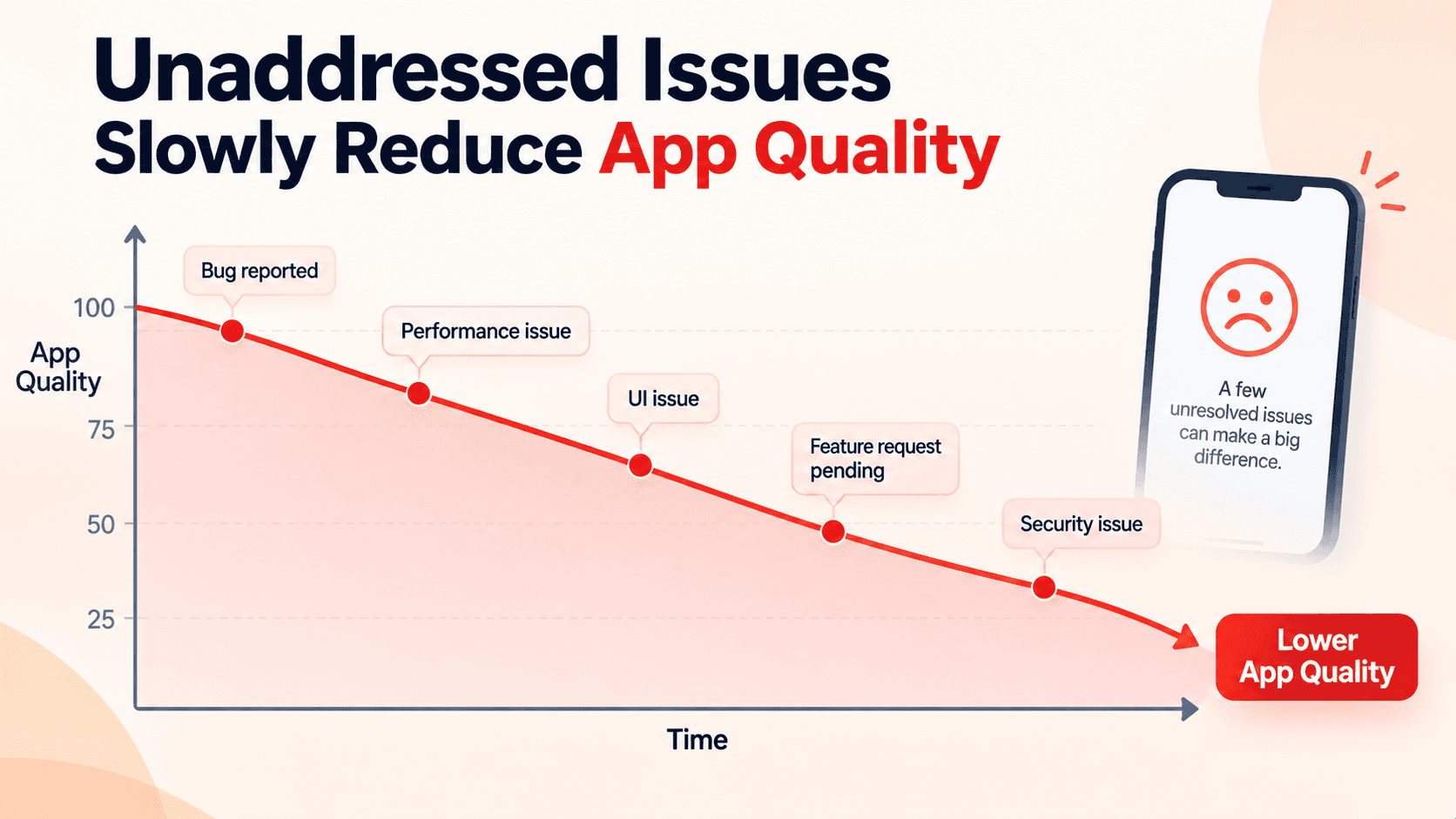 Without maintenance, every unaddressed issue pushes app quality a little lower
Maintenance and Singapore's Data Protection Law
There's one more angle worth covering directly: Singapore's Personal Data Protection Act (PDPA) governs how businesses handle customer data, and app maintenance is where a lot of PDPA risk quietly lives.
An app that collects customer names, phone numbers, or payment details needs to keep handling that data securely. This isn't just true on launch day — it's true for as long as the app is in use. A security patch that's overdue by six months isn't just a technical debt problem. If a vulnerability is exploited and customer data leaks as a result, that's a PDPA compliance failure with real regulatory consequences, not just an embarrassing headline.
This is one more reason maintenance shouldn't be treated as optional overhead. The cost of staying current is almost always smaller than the cost of explaining, after a breach, why a known security gap sat unpatched for months.
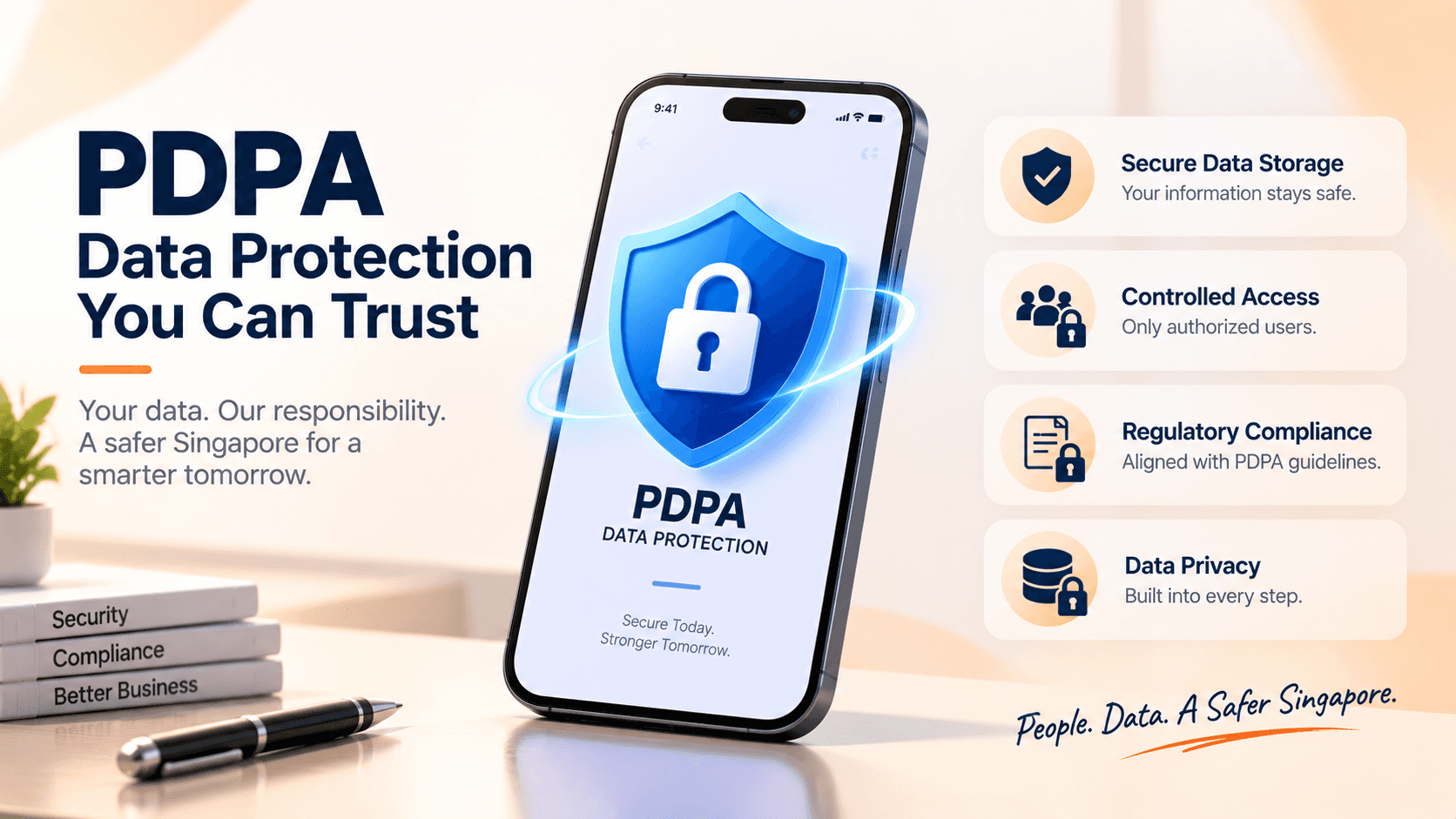 Protecting customer data is an ongoing maintenance job under Singapore's PDPA, not a launch-day task
Web App vs Mobile App Maintenance — Different Risks, Same Discipline
Singapore businesses often run both a website and a mobile app, and it's worth knowing that maintenance risk shows up differently in each.
Web applications depend heavily on browser updates. Chrome, Safari, and other browsers update frequently. A web app that isn't tested against these updates can develop small display or functionality issues that vary by browser — annoying for customers, and hard to diagnose without regular testing.
Mobile applications depend more on operating system updates from Apple and Google, plus app store policy changes that can affect whether an app is even allowed to stay listed without updates. A mobile app that hasn't been updated in over a year can sometimes face store visibility penalties, quite apart from any functional bugs.
Both need the same underlying discipline — regular review, proactive testing, and someone clearly responsible for noticing problems early. But the specific things that break, and how quickly they need attention, genuinely differ between the two.
How Grants Fit Into the Picture — And Where They Don't
Here's something worth knowing if you're a Singapore SME weighing whether to invest properly in maintenance: government support exists, but it doesn't cover everything equally.
The Productivity Solutions Grant (PSG) is run by IMDA and Enterprise Singapore. It funds up to 50% of qualifying costs for pre-approved digital solutions — but only for solutions listed in the official catalogue. The Advanced Digital Solutions (ADS) grant goes further. It funds up to 70% of qualifying costs for more advanced digital transformation projects (source:SMU Academy, Navigating SME Grants in Singapore 2026).
Here's the catch that trips people up: PSG specifically covers pre-approved, largely off-the-shelf solutions. Custom-built software is exactly the kind of app that needs dedicated, ongoing maintenance. But it generally falls outside PSG's scope. Businesses need to look at other schemes instead, like the Enterprise Development Grant, designed for more tailored transformation projects (source:Ledgen Group, Singapore SME Grants and How to Maximise Them).
To qualify for these schemes at all, a business generally needs to meet three conditions. It must be Singapore-registered, with at least 30% local shareholding. And it must be under S$100 million in annual turnover, or have fewer than 200 employees (source:SecureAge, Productivity Solutions Grant).
The practical lesson: don't assume a grant will simply cover your app maintenance costs by default. Check which scheme actually applies to your specific setup — custom-built apps and off-the-shelf tools are treated differently — before building a budget around an assumption that might not hold.
Building a Maintenance Plan That Actually Works
Here's a practical structure for a Singapore business, regardless of size.
Step 1: Set a maintenance schedule, not just a reactive process. Waiting for something to break before fixing it guarantees your customers find problems before you do. A monthly or quarterly review catches issues while they're still small.
Step 2: Track security patches as a standing responsibility, not a project. Someone specific should own checking for and applying security updates — not "whoever has time," which usually means nobody does.
Step 3: Test against new OS releases before they go fully public. Apple and Google typically release developer previews of major updates before the public release. Testing during this window catches compatibility problems early.
Step 4: Set a clear service-level agreement, even if maintenance is handled internally. Decide, in writing, how quickly a critical bug should be fixed versus a minor cosmetic issue. Without this, "urgent" problems can sit for weeks.
Step 5: Keep documentation current, not just the code. If the original developer leaves, clear documentation is the difference between a quick fix and an expensive rediscovery process.
This is exactly the structure behindVeeTee's Application Support and Maintenance service. It includes proactive monitoring, scheduled security patching, and a clear response-time commitment — so problems get caught before your customers experience them.
A Realistic Example
Picture a Singapore retail company running a custom mobile app for loyalty points and in-store ordering, built three years ago by a small local agency that has since moved on to other clients.
For over a year, nobody actively maintained the app. It still technically worked, so nobody flagged it as urgent. Then a major iOS update changed how push notifications were handled. The app's loyalty point notifications silently stopped arriving for a significant share of iPhone users. This went on for weeks, before anyone noticed the drop in redemption rates.
After bringing in a dedicated maintenance plan, the fix itself took only a few days. The bigger change was structural. Someone now actively tests the app against new OS previews before they go public. A monthly review catches small issues long before they become the kind of silent failure that erodes customer trust without anyone noticing in time.
What's Changing Next
Singapore's push toward generative AI adoption will extend into app maintenance itself. IMDA's digitalisation framework increasingly emphasises AI uptake alongside basic digital adoption. AI-assisted testing and monitoring tools are becoming a practical way for smaller teams to catch problems faster than manual review alone.
Security expectations keep rising, not levelling off. As more Singapore SMEs digitise core operations, the cost of a security incident — in trust, not just money — keeps growing, making proactive patching less optional than it used to feel.
Grant schemes will likely keep evolving to cover more ground. As the gap between pre-approved solutions and custom-built software becomes more visible, expect continued adjustments to which schemes cover which kinds of ongoing technology costs — worth checking in on periodically rather than assuming today's rules are permanent.
Frequently Asked Questions
A monthly light check plus a more thorough quarterly review works well for most small and mid-sized apps — critical, high-traffic apps may warrant more frequent monitoring.
Generally no — PSG covers pre-approved, largely off-the-shelf solutions. Custom-built software maintenance typically needs to be evaluated under a different scheme, such as the Enterprise Development Grant.
A rising number of small, seemingly unrelated bug reports is often the clearest early sign — it usually means underlying code quality has been quietly degrading for a while.
Ad hoc maintenance almost always costs more in the long run, because small issues compound into larger ones before anyone prioritises fixing them.
Yes — the absence of an incident so far doesn't mean the risk isn't real; it often just means it hasn't been exploited yet.
The Bottom Line
An app that isn't actively maintained doesn't stay where it was — it quietly moves backward while everything around it moves forward. Build a real maintenance schedule, know which grants actually apply to your setup, and problems get caught in a monthly review instead of a customer complaint.
Get a free app health audit from VeeTee's Singapore support team.Schedule a consultationor exploreVeeTee's Application Support and Maintenance servicesin detail. Visitveeteetechnologies.comto see our full range of services.
Related Reading on the VeeTee Blog
External Sources Referenced in This Article
Grant schemes, funding percentages, and eligibility criteria change periodically — figures in this article reflect publicly available information as of September 2026. Always confirm current terms with IMDA, Enterprise Singapore, or a grant consultant before budgeting around them.
Get in Touch
Contact Us
+91 9500945700
adm@vttech.in
No: 8/65, 1st Floor, Radhakrishnan Street, Shankaran Avenue, Velachery, Chennai, Tamil Nadu – 600042, India.
We’re here to help you !